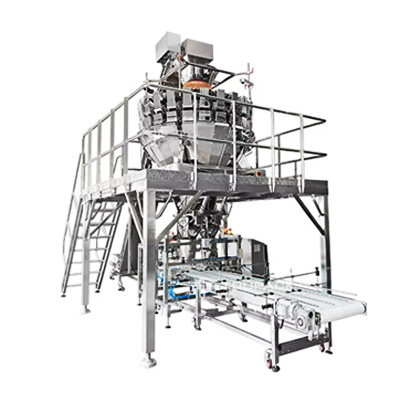
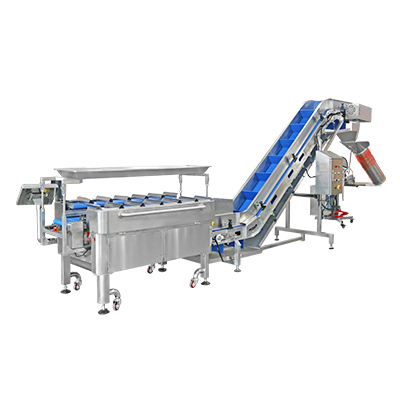
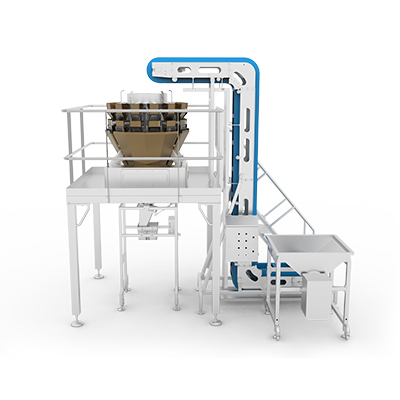
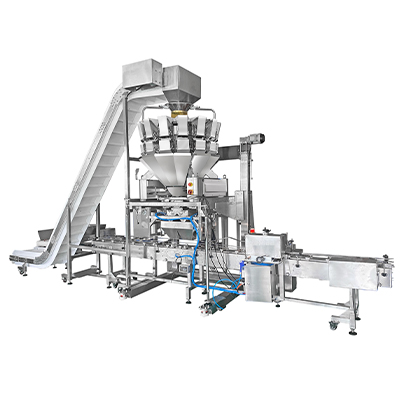
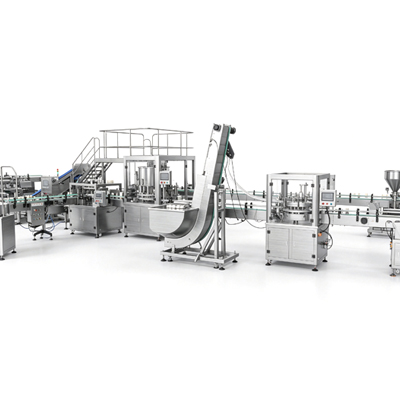
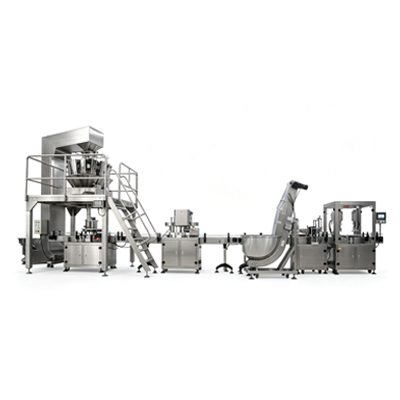
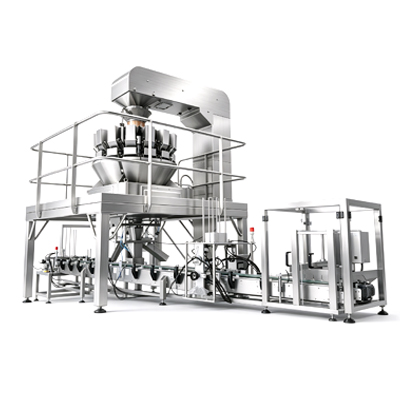
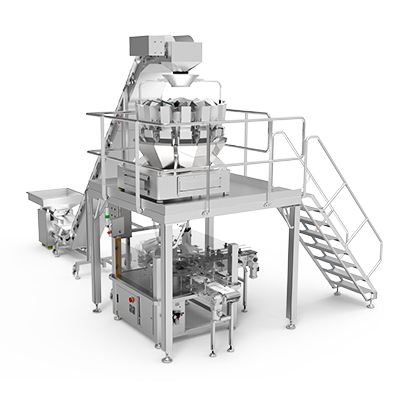
Grab, weigh-guide and load at 0.31 s per cycle. Our delta robot automatic loading & weighing system pairs a 3+1 R parallel-kinematic manipulator with absolute servo drives and integrated weighing feedback to pick, portion and sort meat, fish and poultry at high speed — ±0.1 mm repeatability, SUS304 contact parts, modular CE-compliant frame. Built for fast, hygienic, weight-accurate loading lines.
Most automation on a packing line moves things slowly and carefully or quickly but blindly. A six-axis arm is flexible but heavy and slow at light, repetitive picks; a fixed chute or pusher is fast but cannot adapt to products that differ in size, orientation or weight. The Delta Robot Automatic Loading & Weighing System closes that gap by combining the fastest robot topology in existence — the parallel-kinematic delta — with a weighing module that tells the controller not just where to pick, but what and how much to load. The three vertical actuators sit fixed on the top frame and move only light carbon-style linkage rods, so the moving mass at the end-effector is tiny; the absolute servo drives can therefore accelerate, decelerate and reverse the gripper in milliseconds, completing a full pick-and-place cycle in about 0.31 s. The fourth axis (the “+1 R”) rotates the end-effector, so a product can be re-oriented mid-flight and laid down in the correct heading — essential when portions must sit a certain way in a tray or on a downstream belt.
What makes this a loading and weighing system rather than a plain pick-and-place robot is the closed loop between the scale and the motion controller. As products present on the infeed belt, the weighing function establishes each item’s mass or the running total in the target container; the controller then decides which product (or how many) the delta arm should grab so that the destination reaches its target portion weight without over- or under-fill. In effect the robot becomes the physical executor of a combination-weighing logic: instead of opening and closing weigh-hopper gates, it physically selects and places the right pieces. The result is weight-accurate portions, fully loaded trays and correctly sorted lanes — produced at a pace no operator can match, and with ±0.1 mm placement repeatability that keeps every piece landing in the same spot.
Mechanically, the cell is engineered for the abuse that high-speed motion and food environments impose. A spring-compression limiting stopper cushions the end of travel to prevent shock breakage; a disc-spring spacer preloads the rotary joint for smooth, low-run-out rotation; and a combined thrust-and-needle-roller bearing sub-assembly holds rotary accuracy to 0.01. All contact parts are SUS304 stainless steel, the build complies with CE standards, and the modular frame with a backlash-free end connection and docking flange makes the unit quick to disassemble, service and bolt onto an existing line. In short, this is a high-speed, weight-aware, hygienic handling cell that turns manual loading, portioning and sorting of meat, fish and poultry into a fast, accurate and fully automated motion.
Application Industries
Anywhere a product is priced, dated or tracked by its actual weight, this weigh-print-apply system replaces the scale-and-sticker operator with a single automated station:
Meat & Poultry Processing
High-speed picking and tray-loading of chicken parts, drumsticks, breasts and steaks; weight-guided portioning so each retail tray hits its declared pack weight.
Fish & Seafood
Variable price-weight labels on foam and MAP trays, including pack date, batch and store code, applied without deforming the soft film lid.
Sliced & Portioned Cold Cuts
Stacking and orienting sliced ham, bacon and deli meats into packs, using the +1 R rotation to lay each slice in the correct heading.
Fresh & Frozen Food Packing
Loading of vegetables, dumplings, nuggets and frozen portions into trays, cartons or multi-lane discharge, sorted by counted or weighed combinations.
Industry Pain Points & Professional Solutions
The problems a delta-robot loading-and-weighing cell solves are different from those of inspection or labelling equipment — they are problems of speed, weight accuracy, hygiene and mechanical endurance. Each is answered here by a specific design choice.
1. Why does manual loading cap your line speed and create contamination risk? A person picking wet meat or fish from a belt is the slowest, most variable and least hygienic link in the line — and a food-safety liability.
How this cell resolves it:the parallel robot picks and places at a 0.31 s cycle with no human contact, lifting throughput to a fixed, repeatable rate while removing hands from the product zone entirely.
2. Why are six-axis and SCARA arms too slow or too bulky for light, repetitive picks? Serial arms carry their own motors and mass out at the joints, so they cannot match the acceleration of a lightweight parallel linkage on small, fast moves, and they eat floor space.
How this cell resolves it:the delta topology keeps all heavy actuators on the fixed top frame and moves only slim rods, giving far higher pick-rate per kilogram of payload inside a compact 3D envelope — ideal where space is limited.
3. Why do portions come out over- or under-weight when loading is done by eye or by count? Natural products vary in mass, so counting pieces or guessing by volume misses the target pack weight, causing give-away or short-weight complaints.
How this cell resolves it:the integrated weighing function feeds real mass data to the controller, which selects the combination of pieces that lands the destination on its target weight — the robot executes the same combo-weighing logic a multi-head scale uses, but with physical placement.
4. Why does high-speed motion wear out joints and snap linkages over time? Repeated hard stops and un-preloaded rotary joints cause shock breakage, radial run-out and lost accuracy.
How this cell resolves it:a spring-compression limiting stopper absorbs end-of-travel shock, a disc-spring spacer preloads the rotary joint for smooth low-run-out rotation, and a combined thrust-plus-needle-roller bearing stack holds rotary accuracy to 0.01 — together extending service life under continuous high-cycle duty.
5. Why is orientation wrong when products must sit a specific way in the tray? A 3-axis picker can move a piece but cannot rotate it, so slices or parts land at random headings and must be re-handled.
How this cell resolves it:the +1 R fourth axis rotates the end-effector in flight, so each piece is deposited in the correct orientation for the tray, pack or downstream lane.
6. Why do food-line robots corrode, fail audits or take hours to maintain? Painted frames and sealed-but-not-food-grade joints degrade under wash-down, and bolted-together cells are slow to open.
How this cell resolves it:SUS304 contact parts and a CE-compliant build meet hygiene and safety expectations, while the modular frame with a backlash-free end connection and docking flange lets modules be swapped and the cell docked to the line quickly, cutting downtime.
Core Product Features & Technical Advantages
3+1 R Parallel-Kinematic Architecture
Three fixed vertical actuators drive light parallel rods for X-Y-Z motion while a fourth rotary axis (R) orients the end-effector — the topology that delivers the highest pick-rate for light payloads in the smallest footprint.
0.31 s Pick-and-Place Cycle on Absolute Servo Drives
Absolute servo motors on the low-inertia linkage complete a full grab-move-place cycle in roughly 0.31 s, giving a fast, deterministic throughput that does not drift with wear or power cycling.
Integrated Weighing Feedback for Portioning & Combo Loading
The weighing module supplies live mass data so the controller picks the right piece or combination to hit a target portion or tray weight — turning the robot into the physical arm of a combination-weighing process.
±0.1 mm Placement Repeatability
Tight repeatability ensures every piece lands in the same position, which is what makes weight-accurate tray-filling, neat stacking and reliable downstream handling possible at speed.
Spring-Loaded Limiting Stopper for Shock Protection
A spring-compression stopper cushions the end of travel, reducing impact, avoiding linkage breakage and extending the mechanism’s service life under continuous high-cycle operation.
Disc-Spring Preload & Low-Run-Out Rotary Joint
The disc-spring spacer applies a reasonable preload for smooth rotation, lowering radial run-out and raising rotary precision so the +1 R axis stays accurate over millions of cycles.
Pairing thrust bearings with needle-roller bearings in the rotary sub-chain delivers up to 0.01 rotary accuracy, keeping orientation true even under fast reversing loads.
Backlash-Free End Connection with Docking Flange
A modular, backlash-free transmission and an end flange plate make the cell easy to dock to downstream equipment and keep positional integrity without play building up over time.
Modular SUS304 Frame, CE-Compliant & Food-Safe
Contact parts in SUS304 stainless steel and a CE-compliant, modular frame suit wash-down food environments and allow fast disassembly, reassembly and maintenance.
Automatic Working Process
Product Presentation — Products arrive on the infeed belt conveyor within the 260 mm workable zone, presented singly or in a controlled stream across the pick window.
Detection & Weighing — Each product’s position is detected and its mass established by the weighing function; the controller now knows where every piece is and how much it weighs.
Portion / Combination Decision — Using the live weight data and the target portion or tray weight, the controller selects which piece (or how many) the arm must grab so the destination reaches its target without over- or under-fill.
High-Speed Pick — The 3+1 R parallel arm descends and the end-effector grips the chosen product; the absolute servo drives lift it in a fraction of a second (≈0.31 s full cycle).
3D Transfer with Re-Orientation — The arm translates in X-Y-Z while the +1 R axis rotates the piece to the required heading during the move.
Precise Placement / Loading — The product is released at the target tray, container, lane or downstream belt with ±0.1 mm repeatability, building up a weight-correct portion or a sorted set.
Return & Line Hand-Off — The arm returns to its home position, cushioned by the spring-compression stopper, and the loaded tray or sorted lane advances to the next station through the flanged, backlash-free docking interface.
Technical Specifications
Parameter
Specification
Model
TY-D-H-1400
Degrees of Freedom
3 + 1 R (three translations + one end-effector rotation)
Rated Load
3 kg / 5 kg
Length of Upper Arm
525 mm
Length of Lower Arm
950 mm
Position Repeatability
±0.1 mm
Driving Motor Type
Absolute servo motors
Pick-and-Place Cycle Time
0.31 s
Total Power Consumption
4.5 kW
Power Supply
3 phases 220 V / 3 phases 380 V, 50 Hz
Belt Conveyor Workable Dimension (H)
260 mm
Overall Dimension (L × W × H)
3330 × 1500 × 2568 mm
Air Pressure
Connector Φ12 mm; min. 6 bar (0.6 MPa); consumption 130 NL/min
Working Environment
Temperature 5 °C – 40 °C
Machine Frame / Contact Material
SUS304 for contact parts; CE-compliant build
Rotary Accuracy (bearing sub-chain)
Up to 0.01
End Connection
Modular, backlash-free transmission; end flange docking plate
Rated load, arm lengths, end-effector type (suction / soft-grip / mechanical), weighing range and discharge layout can be tailored to your product, target portion weight and line configuration.
FAQ
Q: Why choose a delta robot instead of a six-axis or SCARA arm for loading?
Because for light, repetitive picks the parallel delta is simply faster and more compact. Its heavy motors stay on the fixed frame and only light rods move, so it accelerates and reverses far quicker than a serial arm of similar payload — and it does so inside a smaller footprint. That is exactly what high-speed portioning and sorting demand.
Q: What does “3+1 R” mean in practice?
Three axes move the end-effector in X, Y and Z (the parallel delta motion), and the “+1 R” is a rotary axis that spins the gripper. The rotation lets you re-orient a product in mid-air so it lands in the correct heading — important when slices or parts must sit a specific way in a tray.
Q: A 0.31 s cycle sounds fast — what throughput does that give?
Roughly a pick-and-place every 0.31 s, i.e. on the order of three cycles per second at the mechanism level, far above manual or serial-arm rates for light products. Real line throughput depends on product presentation and the number of picks per placement, but the mechanism itself is not the bottleneck.
Q: How does the “weighing” part work together with the robot?
The weighing function measures each product (or the running total in the target) and the controller uses that mass to decide which piece or combination to grab so the destination reaches its target portion weight. In other words the robot physically executes a combination-weighing decision — selecting and placing the right pieces rather than just moving whatever comes next.
Q: Can it really handle wet, slippery meat and fish without damaging them?
Yes — that is a primary use case. The end-effector is chosen to suit the product (gentle suction, soft grippers or compliant fingers), the parallel arm’s smooth servo motion avoids jerking, and no human hand touches the product, which also improves hygiene on wet protein lines.
Q: How is accuracy maintained at such high speeds and cycle counts?
Through the mechanism design: ±0.1 mm placement repeatability from the rigid parallel linkage and absolute servos, a disc-spring preloaded rotary joint for low run-out, a thrust-plus-needle-roller bearing stack holding 0.01 rotary accuracy, and a spring-compression stopper that protects the structure from shock — so precision does not decay as cycles accumulate.
Q: What utilities does the cell need on site?
Electrical supply of 3-phase 220 V or 3-phase 380 V at 50 Hz (≈4.5 kW total), and clean compressed air via a Φ12 mm connector at a minimum of 6 bar (0.6 MPa) with about 130 NL/min consumption, within a 5 °C–40 °C working environment.
Q: Is it suitable for food lines and easy to maintain?
Yes. Contact parts are SUS304 stainless steel and the build is CE-compliant for safety, while the modular frame and the flanged, backlash-free end connection let technicians disassemble, service and re-dock the cell quickly — minimising the downtime that high-speed lines cannot afford.
Contact Us
Planning to automate a slow, labour-heavy loading, portioning or sorting step — especially on wet meat, fish or poultry lines? Our application engineers will size the right payload, cycle rate, end-effector, weighing range and discharge layout for your product, free of charge.
Product Description
Submit Your Requirements
Please submit your requirement form, and we will customize the most suitable solution according to your needs.
Automated mesh bagging extends produce shelf life by providing vital airflow. Upgrading your line slashes labor costs, stops product giveaway, and maximizes daily output.
Dust-controlled powder fillers use vacuum extraction and servo-driven augers to package fine materials. These automated systems prevent waste, ensure safety, and maximize ROI.
Horizontal packaging machines use lateral movement to safely package solids, powders, and liquids. These systems ensure leak-proof seals, cut labor costs, and maximize your ROI.
It is a high-tech enterprise specializing in the R&D, design, and independent manufacturing of packaging, conveying, weight detection, weighing, and filling equipment.