You are here:Home / Products / Weigher / Linear Weigher / 4-Head Linear Weigher 3.0L Large Hopper | Bulk Granule Powder Weighing Machine 20–2000g High Capacity
loading
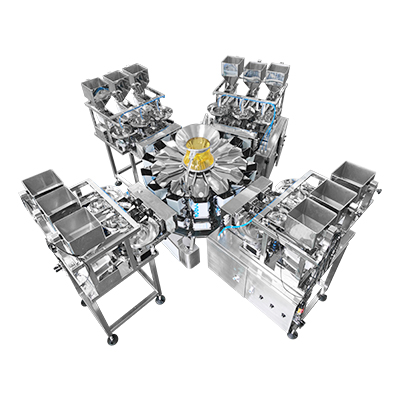
4-Head Linear Weigher 3.0L Large Hopper | Bulk Granule Powder Weighing Machine 20–2000g High Capacity
Single-layer 4-head linear weigher with 3.0L large independent hoppers, X(0.5) stable precision, max speed 40bpm, MCU + 7/10 inch touch HMI. For large-batch grain, nut, sugar, feed, seasoning bulk weighing, free material test available.
4-Head Linear Weigher (3.0L) — The Big-Hopper, Wide-Range Workhorse for 500g–2kg Granule & Powder Bags
A 0.5L hopper starves a 1kg bag line every few cycles — and a multihead weigher costs three times as much for a job four heads can do. This suspended, 3.0L, 20–2000g unit kills the refill stops, covers your whole bag range on one scale, and hangs over your filler so it never eats your floor.
Industry Pain Points
The Four Stops That Kill a Mid-to-Heavy Bag Line
If you pack 500g–2kg bags of rice, sugar, coffee, grain or pet food, your line does not fail on precision — it fails on flow. These are the four stops your shift supervisor counts every single day:
The Refill Stop — A small hopper empties in a handful of 1kg bags, so an operator leaves their station every few minutes to shovel product back in. Every refill is a micro-stop, and twenty micro-stops a shift is a missing pallet by Friday. This is exactly the question behind how to weigh large volume granules without babysitting the hopper.
The Heavy-Bag Speed Collapse — Your weigher is rated 40 bpm on a 100g sachet, but the moment you load a 1kg rice bag the head can't fill fast enough and the line drops to 20. The "speed" on the brochure was never the speed on your bag.
The One-Scale-One-SKU Trap — You run 100g seasoning sachets and 1kg rice and 2kg pet food, so you bought three machines — or you change-over one tiny machine three times a day and lose an hour each time.
The Whole-Bean Bridge — Irregular, low-density product — coffee beans, puffed kibble, millet, odd-shaped seeds — jams and bridges in a small feed tray, so the head under-fills and the line faults. Operators searching for a machine for irregular shaped seeds usually land here after a small-hopper unit has already failed them.
Add a fifth, quieter cost: a micro-dose or table-top scale bolted to a fabricated frame that swallows half your floor — floor a small plant cannot spare.
The Solution
One Suspended Unit. A 3.0L Hopper. A 20–2000g Range. The Refill Stop, Solved at the Source.
The 4-Head Linear Weigher (3.0L) is engineered around a single, unfashionable truth: on a mid-to-heavy bag line, throughput is decided by how often you stop, not by how fast one cycle is. So every choice on this model attacks the stops above:
Hopper size → no refill stops: a genuine 3.0L weighing hopper per head holds enough product to ride out long runs of 1kg–2kg bags, so the operator is loading a bulk supply, not shovelling between cycles. This is the 3.0L hopper linear weigher answer to the refill stop.
Range width → one scale, every SKU: a 20–2000g weighing range on a 20-2000g linear scale means the same four heads dose a 100g seasoning sachet and a 2kg rice bag from one recipe library — no second machine, no daily change-over.
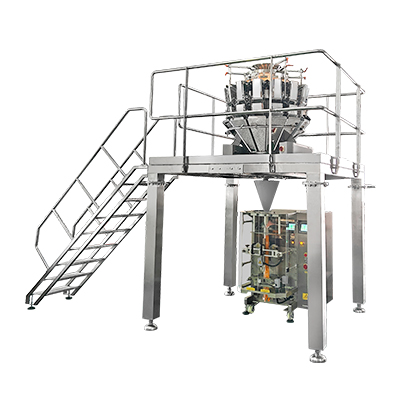
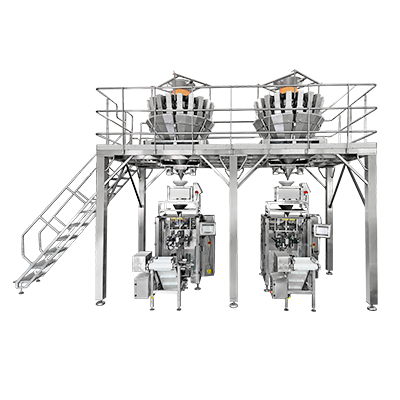
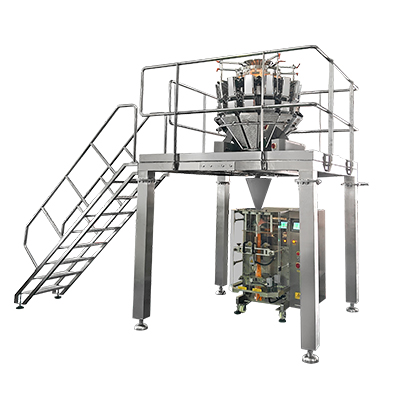
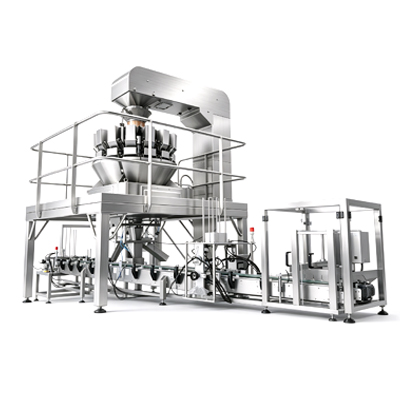
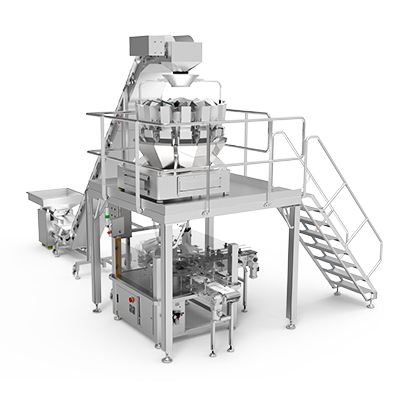
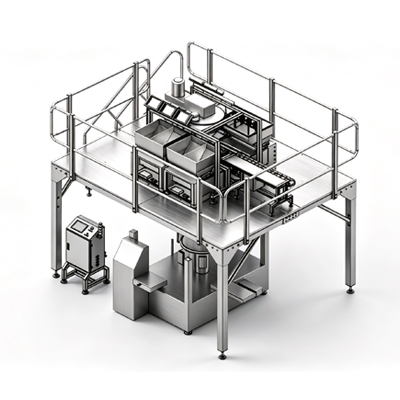
Mount → floor back to the plant: a suspended / table-mount body with a large conical discharge funnel hangs directly over your filler and gravity-feeds it, so the weigher occupies air, not floor — a compact weighing solution for small factory layouts in the only sense that matters to a small plant: zero ground footprint.
Head geometry → whole-bean friendly: wide, smooth feed paths and 3.0L heads swallow coffee beans, puffed kibble, millet and irregular seeds without the bridging that chokes a small tray.
The result is a line whose OEE climbs for the unglamorous reason that it simply stops less — and a capital spend that, for a 20–2000g SKU family, beats a multihead on the only number the CFO reads: cost per bag across the whole range. Whether you are building a new line as a granule weighing system or rescuing an existing one as a vertical packing machine accessory mounted overhead, this is the module that removes the stops nobody put on the Gantt chart.
Core Advantages
Advantage 1 — A 3.0L Hopper That Ends the Refill Stop
Feature: Four independent 3.0L weighing hoppers fed from a wide top surge tray — a true 3.0L hopper linear weigher, six times the per-head capacity of a micro-dose unit.
Advantage: Each head carries enough product to sustain long sequences of 500g–2kg bags before the bulk supply needs topping up, so refilling becomes a scheduled task between runs instead of a reactive stop mid-cycle.
Benefit: Your operator stops shovelling and starts supervising. The twenty micro-stops per shift vanish, the line holds its rhythm on heavy bags, and the pallet that was missing on Friday ships on Friday. This is the practical answer to how to weigh large volume granules without a person chained to the hopper.
Advantage 2 — A 20–2000g Range That Replaces Three Machines With One
Feature: A single 20–2000g weighing window at X(0.5) accuracy and 0.1g resolution, stored as switchable recipes on the 7-inch / 10-inch touch screen — a 20-2000g linear scale that spans sachet to 2kg bag.
Advantage: The same four heads, re-tuned per recipe, dose a 100g seasoning pack and a 2kg rice bag without hardware change-over — the wide range is what makes one scale cover a whole SKU family.
Benefit: You stop buying a machine per product and stop losing an hour per change-over. For a co-packer or a brand with a broad bag portfolio, one automatic weighing machine doing every SKU is a capital line and a labour line saved — and the affordable 4 head weigher price tag is what makes that math close.
Advantage 3 — 40 bpm That Holds on the Heavy Bag, Not Just the Sachet
Feature: Four heads on an efficient high speed linear feeder, sequenced so a filling head always overlaps a discharging head, sustaining 40 bpm across the range — driven by an industrial MCU with per-head feed tuning.
Advantage: Because the 3.0L head can physically fill a 1kg dose inside one cycle window, the 40 bpm figure does not collapse on heavy bags the way it does on a small-hopper unit — the speed you read is the speed on your bag.
Benefit: The line rate you model in the quote is the line rate you get on the floor. As the rice and sugar weighing machine on a 1kg retail line, it keeps the bagger fed at full cadence instead of throttling it the moment the dose gets heavy.
Advantage 4 — Whole-Bean & Coarse-Granule Friendly, Suspended to Save Your Floor
Feature: Wide, smooth, bridge-resistant feed paths into 3.0L heads, in a suspended / table-mount stainless body with a large conical discharge funnel, built as a stainless steel weigher supplier food-grade unit.
Advantage: Irregular, low-density product — coffee beans, puffed kibble, millet, odd seeds — flows instead of jamming, and the suspended body with its gravity discharge cone mounts over the filler as a vertical packing machine accessory, occupying air rather than floor.
Benefit: Faults from bridging drop out, and a cramped plant gets its ground back — which is precisely why this is the compact weighing solution for small factory that a small plant can actually fit: it asks for ceiling height, not square metres. Still weighing a linear weigher vs multihead weigher cost decision? On irregular, low-density product at 20–2000g with frequent SKU changes, the four-head linear wins on cost-per-bag and on jam-free running — the multihead only pulls ahead on ultra-high-speed fine-granule lines you are not running.
Application Scenarios
Granular and powdery materials across the mid-to-heavy range — sugar, rice, chicken essence, seeds, salt, milk powder, coffee, seasoning — dosed into 500g–2kg retail, food-service and agri bags. This is food packaging weigher throughput on whole grains and powders alike.
Scenario 1 — 1kg & 2kg Rice, Sugar & Salt Bags Free-flowing rice, sugar and salt into 1kg–2kg retail bags is pure volume economics, and the enemy is the refill stop. Mounted overhead as a rice and sugar weighing machine, the 3.0L heads ride out long heavy-bag runs while the wide range keeps the same unit on the 500g SKU tomorrow — no change-over, no second scale. If you are asking what the best scale for 1kg rice packing looks like in practice, it is the one whose hopper is big enough that the operator is not part of the cycle time — and that is this 3.0L platform.
☕ Scenario 2 — Whole-Bean & Ground Coffee Bags Whole coffee beans are the textbook irregular, low-density product that bridges in a small tray and under-fills a small head. As a coffee bean weighing scale, the wide feed paths and 3.0L heads let the beans flow and settle, holding the dose on 250g–1kg retail and food-service bags without the jam-faults that plague micro-dose units on the same product.
Scenario 3 — Pet Food Kibble, Millet & Irregular Seeds Puffed pet-food kibble, millet and irregular seeds are bulky, fragile and odd-shaped — exactly the load that exposes a small-hopper machine. Here the unit earns its keep as a pet food linear weigher and a machine for irregular shaped seeds: the 3.0L heads swallow the surge without crushing the kibble, the suspended cone gravity-feeds the bagger, and 40 bpm holds on a 1kg–2kg agri or pet bag because the head can fill it inside the window.
Technical Specifications
Grouped the way a mid-to-heavy buyer evaluates: dosing capacity first (because the hopper and range are the product), then control and electrical, then the physical envelope and weights that decide your mount and your freight. Power and weights are stated exactly as the data sheet specifies them — 1.0kW, 163/230kg — not borrowed from a smaller model.
Dosing Performance
Parameter
Value
Model
TY-ZX041M30-02-11
Weighing Range
20 – 2000 g
Accuracy
X(0.5)
Minimum Scale Interval
0.1 g
Maximum Speed
40 bpm
Hopper Volume
3.0 L
Control & Electrical
Parameter
Value
Control System
Industrial MCU (per-head tuning + recipe library)
HMI
7" / 10" colour touch screen
Power Supply
AC220V / 110V ±10%, 50/60 Hz, 1.0 kW
Form Factor & Weights
Parameter
Value
Packing Dimensions
1510 (L) × 1020 (W) × 950 (H) mm
Net Weight
163 kg
Gross Weight
230 kg
Mounting
Suspended / table-mount with conical discharge funnel
In plain terms, this is the 4-head linear weigher mid-to-heavy lines default to when the bag is 500g–2kg and the stops are costing them a pallet a week.
Quality & After-Sales
Certified to Export. Honest on Capacity. Backed Wherever It Hangs.
Certified — CE & ISO. Built and tested to CE and ISO standards, with the documentation that clears EU, North American and GCC customs on the first pass — the paperwork a serious stainless steel weigher supplier ships as standard.
Honest — we size the hopper to your bag, not the demo. We will tell you when a 3.0L / 20–2000g platform is the right, stop-killing choice for your heavy bags — and when your line genuinely needs a micro-dose or a multihead instead. That candour is why operations teams trust the quote.
Hygienic & rugged — food-grade contact, line-grade body. Product-contact surfaces in SUS304 / 316 stainless with clean, weld-free corners; the suspended body and discharge cone are built to take the daily vibration of a grain, coffee or kibble line.
Guaranteed — 1-year warranty, 48-hour spares. A documented wear-parts schedule ships with every unit and stocked spares dispatch within 48 hours, because on a 40 bpm line a worn feed tray cannot become a week of silence.
Supported — mounted to your filler and your grid. We confirm your mount (suspended or table), return a discharge-cone height drawing matched to your bagger, and pre-tune feed parameters on video for your product — so the linear weighing scale arrives configured for your bag, your mount and your socket.
FAQ
Q1 — Will the 3.0L hopper really stop the refill stops on 1kg–2kg bags, and does 40 bpm hold on a heavy bag?
Yes on both, and they are the same answer. The refill stop exists because a small hopper empties in a few heavy bags; a 3.0L head holds enough product that topping up becomes a scheduled task between runs, not a reactive stop mid-cycle — which is the real fix behind how to weigh large volume granules without an operator in the loop. The 40 bpm holds on the heavy bag for the same physical reason: the 3.0L head can actually fill a 1kg–2kg dose inside one cycle window, so the speed does not collapse the way it does on a small-hopper unit. The honest caveat is that your achievable rate is the lower of the weigher's 40 bpm and your bagger's rated cycle, so send us your target bag weight and your bagger's speed and we will model the pair before you commit.
Q2 — Can one 20–2000g unit genuinely cover my 100g sachet, my 1kg rice and my 2kg pet food, and how fast is the change-over?
That wide range is the entire point of the platform. The same four heads, re-tuned as saved recipes on the touch screen, dose a 100g seasoning sachet and a 2kg rice or kibble bag with no hardware change-over — you switch products in the HMI, not with a wrench. The 0.1g resolution keeps the small sachet inside its label tolerance while the 3.0L head and 2kg ceiling handle the heavy bag, so one automatic weighing machine replaces the two or three single-range units a narrow machine would force you to buy. If your portfolio spans sachet-to-2kg, this is the configuration that turns three capital lines and three daily change-overs into one.
Q3 — For my irregular product and my small floor, why this over a multihead — and what about voltage and lead time?
Three honest reasons. First, on irregular, low-density product — coffee beans, puffed kibble, millet, odd seeds — the wide, bridge-resistant feed paths of a four-head linear run jam-free where a small tray bridges, so you win on uptime, not just price; that is the practical answer to a linear weigher vs multihead weigher cost question on this kind of product, because the multihead's speed advantage disappears the moment it jams on your beans. Second, the suspended body with its discharge cone hangs over your bagger and gravity-feeds it, so it asks for ceiling height instead of square metres — which is why it is the compact weighing solution for small factory a cramped plant can actually fit. Third, the AC220V / 110V ±10%, 50/60 Hz, 1.0 kW supply covers essentially every export grid on one SKU, so the same unit runs in a 230V or 120V plant unchanged. Standard configurations ship on a published lead time; a customised mount height, hopper finish or HMI language adds a short, quoted extension — and the quote you receive reflects exactly that configuration, including the mount and the lead time, not a bare-unit list figure.
Send Us Your Heaviest Bag, Your Worst Refill Stop and Your Mount. We'll Return the Stop-Free Answer in 24 Hours.
Mid-to-heavy lines do not need a more precise machine — they need one whose hopper is big enough to stop the refills, whose range is wide enough to cover the SKU family, and whose mount gives the floor back to the plant. So skip the generic list price. Send us three things and we will do the engineering.
[Get a Free Stop-Free Quote & 40 bpm Heavy-Bag Line Model] [Request a Suspended-Mount Discharge-Cone Drawing for Your Filler] [Run the Range Calc with a Weighing Engineer — Reply Within 24h]
No obligation. No over-specified upsell. Just a big-hopper, wide-range, suspended four-head solution sized to your heaviest bag — and the lead time to match.
Disclaimer: Machine renderings, engineering dimension drawings and all technical parameters displayed on this page are for reference purposes only. Please consult our professional sales engineer to confirm customized specifications matching your granule size, multi-spec mixed wholesale sack packing layout and hourly ton-level bulk throughput demands.
Product Description
Submit Your Requirements
Please submit your requirement form, and we will customize the most suitable solution according to your needs.
Automated mesh bagging extends produce shelf life by providing vital airflow. Upgrading your line slashes labor costs, stops product giveaway, and maximizes daily output.
Dust-controlled powder fillers use vacuum extraction and servo-driven augers to package fine materials. These automated systems prevent waste, ensure safety, and maximize ROI.
Horizontal packaging machines use lateral movement to safely package solids, powders, and liquids. These systems ensure leak-proof seals, cut labor costs, and maximize your ROI.
It is a high-tech enterprise specializing in the R&D, design, and independent manufacturing of packaging, conveying, weight detection, weighing, and filling equipment.