You are here:Home / Products / Weigher / Linear Weigher / 4-Head Linear Weigher 10L Super Large Hopper | Industrial Heavy-Duty Granule Powder Weighing Machine 200–5000g High Volume
loading
4-Head Linear Weigher 10L Super Large Hopper | Industrial Heavy-Duty Granule Powder Weighing Machine 200–5000g High Volume
Industrial single-layer 4-head linear weigher with four independent 10L ultra-large weighing hoppers, X(1) consistent precision, max speed 50bpm, MCU + 7/10 inch touch HMI. Built for industrial big-bag grain, feed, nuts, chemical powder bulk weighing, free material test support.
4-Head Linear Weigher (10L) High Speed — The 50bpm-at-5kg Throughput King for the World's Standard 5kg Bag
An auger line crawls at 20bpm on a 5kg bag, a multihead that hits 50bpm costs twice as much and still needs the same cleaning downtime, and a suspended unit has nowhere to hang in a plant with no overhead structure. This self-standing, 10L, 200–5000g unit runs 50bpm on the actual 5kg bag, bolts to the floor with its own legs, and draws less power than the slow machine it replaces.
Industry Pain Points
The Four Walls That Cap a 5kg-Bag Line Below Its Target
If you pack 2.5–5kg bags of rice, sugar, milk powder, coffee, seed or pet food at a target cadence, your line does not fail on the bagger — it fails on the weigher's ability to move a five-kilo dose fast enough, cleanly enough, and without a structure it can't mount to. These are the four walls your production planner hits every shift:
The Auger Crawl — A single-head auger filler is the default for 5kg bags, and it is honest but slow: 15–25bpm is its ceiling because one screw has to meter five kilos, settle, and re-zero every cycle. Your "high speed" target of 40–50bpm is physically unreachable on that architecture. This is the doubt behind how many bags per minute can a linear weigher run at 5kg — and on an auger the answer is "nowhere near your target."
The Refill Tax on Big Bags — A small hopper empties in a handful of 5kg bags, so an operator leaves their station every few minutes to shovel product back in. At 50bpm on a 5kg dose you are moving 250kg a minute — a small hopper cannot keep up, and every refill is a micro-stop that costs a pallet by Friday.
The Powder Wall at Speed — Milk powder, cocoa and fine seasoning at a 5kg dose and a 50bpm cadence fluidise, dust and swing in bulk density, so a head under-fills, the bag fails weight, and the line faults. Most "high speed" units were never tested on a five-kilo powder surge — they were tested on free-flowing grain. Operators asking can a linear weigher handle milk powder at 50bpm usually land here after a grain-only unit has already contaminated a powder run.
The "Nowhere to Hang" Wall — A suspended weigher needs overhead structure or a fabricated support frame. A greenfield line, a retrofit into an existing hall, or an export customer with a bare concrete floor has neither — so the install stalls on steelwork nobody budgeted, paid for in weeks of delay.
A fifth, quieter wall: a weigher rated "50bpm" that earned that number on a 200g sachet and quietly drops to 20 the moment you load the 5kg bag you actually bought it for — the speed-ceiling lie, reprised at the heavy end.
The Solution
50 bpm on the Real 5kg Bag. Bolts to the Floor. Cleans in Minutes. Draws 0.6kW. The Walls, Taken Down One by One.
The 4-Head Linear Weigher (10L) High Speed is engineered around a single, unfashionable truth about heavy-bag throughput: speed only means something at the dose you actually run, and a 5kg line is won or lost on feeding, mounting and cleaning — not on the number printed for a sachet. So every choice on this model attacks the four walls above with a mechanism, not a marketing line:
Four heads at 5kg → the auger crawl ends: four independent heads share the 5kg workload and discharge in overlap, so the line sustains 50 bpm on the actual 5kg bag — roughly double an auger's ceiling — because no single mechanism has to meter, settle and re-zero five kilos alone. This is the high speed linear weigher for large bags answer to the auger crawl, and the 50bpm figure is measured at the dose you run, not on a 200g demo.
10L head → the refill tax disappears: a 10L weighing hopper per head, fed from a top surge reservoir through a pyramid four-lane divider, stores and distributes enough product that at 50bpm on a 5kg dose the heads are topped between discharges instead of starved — the 10L hopper linear weigher sized to the 250kg-a-minute reality, not the brochure.
Powder-tuned feed → the powder wall comes down: adjustable feed amplitude, anti-fluidisation tray geometry and enclosed paths let milk powder, cocoa and fine seasoning dose at 50bpm without the dusting and density swing that under-fill a grain-only head — so the granule and powder linear weigher runs both morphologies on one platform, cleaned between SKUs in minutes rather than hours.
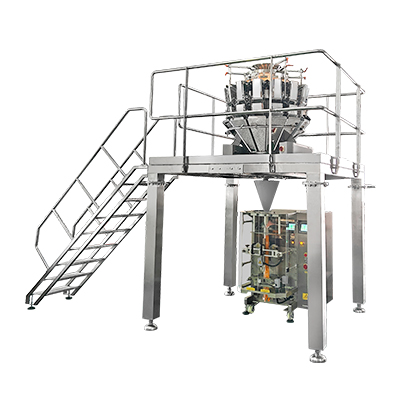
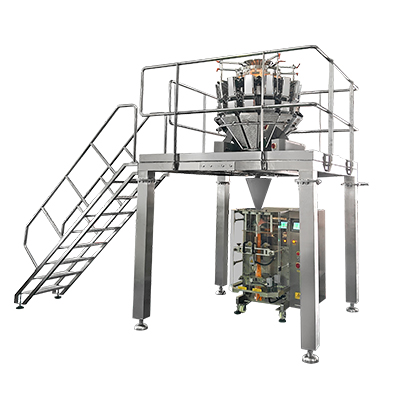
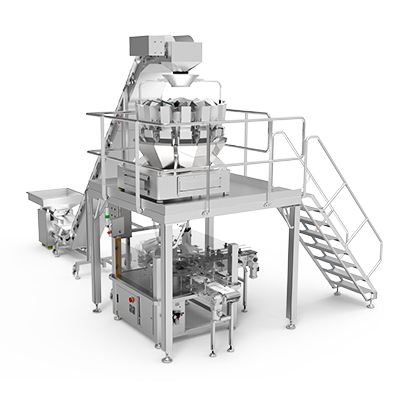
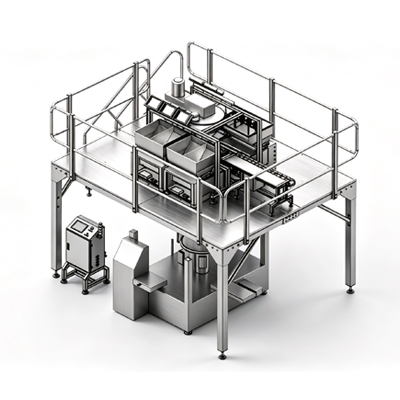
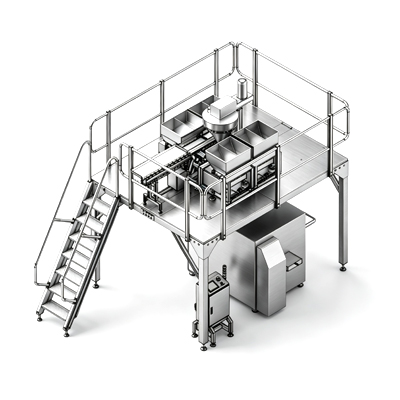
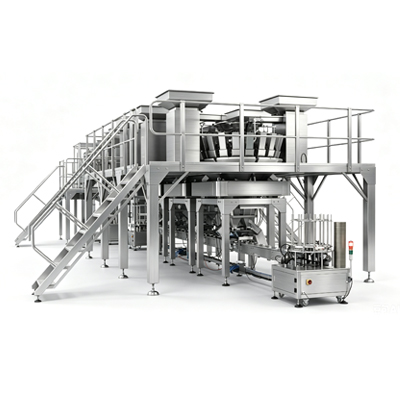
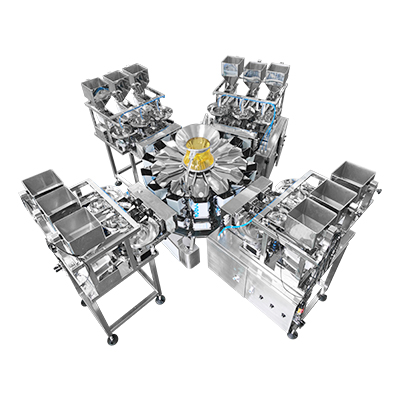
Self-standing body → the "nowhere to hang" wall, gone: an integrated floor-standing, self-supporting frame with its own legs bolts directly to the concrete — no overhead structure, no fabricated steelwork, no ceiling height dependency. The self-supporting floor standing linear weigher ships as one rigid 350kg unit that holds its calibration at 50bpm because the mass is the stability.
The result is a 5kg-bag line whose OEE climbs for three unglamorous reasons: it doubles the auger's cadence, it stops for refills and cleaning far less often, and it installs in a bare hall without a welder on site. And because the electrical draw is only 0.6kW — the muscle borrowed from efficient actuation rather than a brute-force motor — it plugs into an ordinary export circuit while out-running machines that draw three times the power. Whether you are scoping it as a four head weigher for heavy doses on a new 5kg line or dropping it into an existing hall as a 5kg bag weighing machine, this is the module that removes the walls nobody put on the Gantt chart.
Core Advantages
50 bpm Measured at the 5kg Bag, Not the Sachet
Feature: Four independent heads discharging in overlap, sequenced by an industrial MCU, sustaining 50 bpm across the 200–5000g range — a 50bpm linear weigher for 5kg bags, with the speed verified at the heavy dose rather than extrapolated from a light one.
Advantage: Because four heads share the five-kilo workload, no single mechanism has to meter, settle and re-zero 5kg alone, so the cadence holds where an auger throttles to 20bpm and where a "50bpm" sachet-rated unit quietly collapses on the real bag.
Benefit: The line rate in your quote is the line rate on the floor for the bag you actually sell. If you have been asking how many bags per minute can a linear weigher run at 5kg, the honest answer is "as many as the head architecture allows at that dose" — and on this four-head 10L platform that answer is 50bpm at 5kg, modelled against your target before you commit.
A 10L Hopper and Pyramid Divider Sized to 250kg a Minute
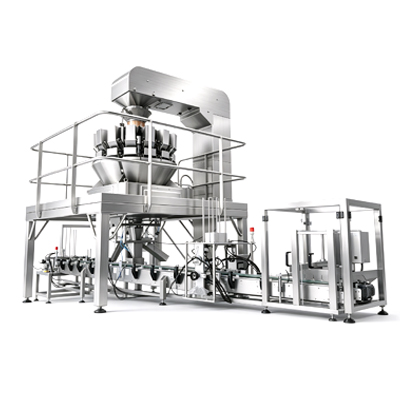
Feature: Four 10L weighing hoppers under a top stainless surge box, fed through a pyramid four-lane divider that splits the surge evenly to each head — a 10L hopper linear weigher and a 200-5000g linear scale in one rigid body.
Advantage: At 50bpm on a 5kg dose the line moves 250kg a minute, so the 10L heads plus the even-split divider keep every head topped between discharges instead of starving mid-cycle — the hopper volume and the divider geometry are the arithmetic result of that flow, not vanity numbers.
Benefit: Refilling becomes a scheduled top-up of the surge box between runs, never a reactive stop mid-cycle, and no head runs dry while another overflows. Wondering what hopper size do I need for 5kg rice bags at a 50bpm target? It is the size whose surge-backed, evenly-divided heads out-run a 5kg discharge — and at 250kg a minute that size is 10L per head.
Granule and Powder on One Platform, Cleaned in Minutes
Feature: Adjustable feed amplitude, anti-fluidisation tray geometry and enclosed product paths in food-grade stainless, switchable per recipe on the 7-inch / 10-inch touch screen — a granule and powder linear weigher that handles free-flowing grain and cohesive fine powder on the same heads.
Advantage: The feed tuning and enclosed paths stop milk powder, cocoa and fine seasoning from fluidising, dusting and swinging in bulk density at a 5kg surge, while the open, weld-free stainless surfaces and quick-release trays let an operator strip and clean between a powder SKU and a grain SKU in minutes rather than the hours a multihead demands.
Benefit: You run powder at speed without the under-fill faults, and you change SKUs without losing a shift to cleaning — one platform covering the powder bags a grain-only unit could never reach. So can a linear weigher handle milk powder at 50bpm? On a grain-only head, no — it fluidises and under-fills; on this powder-tuned, enclosed, recipe-switched platform, yes, at the 5kg food-service dose, with cleaning fast enough to make multi-SKU powder runs economical.
Self-Standing, Bolt-Down, and 0.6kW: Installs in a Bare Hall, Runs on an Ordinary Circuit
Feature: An integrated floor-standing, self-supporting stainless frame with its own legs and a central handled discharge cone, drawing only 0.6kW electrical, topped with a status tower light — a self-supporting floor standing linear weigher that needs no overhead structure and no grid upgrade.
Advantage: Because the unit carries its own rigid 350kg frame, it bolts to bare concrete with no fabricated steelwork and no ceiling dependency, and because the heavy lifting is done by efficient actuation rather than a brute-force motor, the electrical load stays at 0.6kW — a fraction of the 2–3kW an equivalent auger or multihead line draws.
Benefit: A greenfield line, a retrofit or an export customer with a bare floor gets a running 50bpm 5kg line without a welder on site and without a panel upgrade in the CAPEX — and the 350kg mass holds calibration at speed instead of drifting under vibration. Still deciding linear weigher or multihead for 5kg powderbags? On 5kg powder the four-head linear matches the cadence, cleans between SKUs in minutes instead of hours, draws a third of the power, and costs a fraction of the capital — the multihead only pulls ahead on ultra-fine, ultra-high-speed lines well beyond the 5kg bag class.
Application Scenarios
Granular and powdered products across the heavy range — sugar, rice, chicken essence, seeds, salt, milk powder, coffee, seasoning — dosed into 2.5–5kg retail, food-service and agri bags at a 50bpm cadence. This is the 5kg rice packing machine price point a multihead cannot touch, and the linear weigher for 5kg rice and sugar bags that doubles an auger line's output on the same floor.
Scenario 1 — 5kg Rice, Sugar & Salt Retail Bags Free-flowing rice, sugar and salt into the world's standard 5kg retail bag is pure volume economics, and the enemy is the auger crawl. As a linear weigher for 5kg rice and sugar bags, the four heads share the five-kilo dose and hold 50bpm where a single auger tops out at 20, while the 10L surge-backed heads keep the line fed through a full shift — so the 50bpm you modelled is the 50bpm you ship, bag after bag, on the most common staple bag on earth.
Scenario 2 — 5kg Milk Powder & Cocoa Food-Service Bags Milk powder and cocoa in 2.5–5kg food-service and dairy-supply bags combine a powder's cohesion with a heavy dose and a fast cadence — the exact load that fluidises and under-fills a grain-only head. As a milk powder bagging scale for 5kg foodservice bags and a coffee and cocoa powder linear weigher, the powder-tuned feed and enclosed paths dose the five-kilo powder surge at 50bpm without dusting or density swing, and the quick-clean stainless lets a dairy co-packer switch from milk powder to cocoa between runs without losing the shift — one platform covering the powder SKUs an auger or grain-only unit could never reach at speed.
Scenario 3 — 5kg Seed, Grain & Pet Food Bags Seed, grain and pet-food kibble in 2.5–5kg agri and e-commerce bags are bulky, sometimes abrasive, and packed at volume. Here the unit earns its keep as a seed and grain bagging machine for 5kg agri bags and a pet food 5kg bag weighing scale: the 10L heads swallow the surge without crushing the kibble or bridging the seed, the pyramid divider keeps all four heads fed evenly at 250kg a minute, and the self-standing frame bolts into a bare agri shed or a fulfilment warehouse with no overhead structure — so a 5kg seed, grain or kibble bag runs at full cadence on a floor that had nothing but concrete to offer.
Industrial Large Grain Jumbo Sack Packing
Extra long polished rice, mixed giant beans, millet, sorghum industrial woven ton sacks, multi-grain blend ultra-heavy bulk portions
Grouped the way a 5kg-bag buyer actually evaluates: throughput and dosing first (because the speed-at-dose, the head and the range are the product), then the accuracy-and-control line that decides whether QC signs off, then the structure-power-mount block that decides your floor, your socket and your install. The speed is stated honestly as 50bpm across the range including 5kg, the power as 0.6kW, and the structure as self-standing — not borrowed from a suspended or auger model.
In plain terms, this is the 10L hopper linear weigher and 5kg bag weighing machine a 50bpm staple-bag line defaults to when the bag is 5kg, the floor is bare concrete, the SKU list includes powder, and the socket is ordinary.
Quality & After-Sales
Certified, Self-Standing, and Honest About the Dose It Was Built For.
Certified — CE & ISO. Built and tested to CE and ISO standards with the documentation that clears EU, North American and GCC customs on the first pass — the paperwork a serious linear weigher manufacturer for 5kg bag lines ships as standard.
Honest about speed — we rate it at the bag you run. We publish 50bpm verified at the 5kg dose, not extrapolated from a 200g sachet, and we will tell you plainly when your line genuinely needs a multihead (ultra-fine, ultra-high-speed) or an auger (single-SKU, low-capital) instead. That candour is why production planners trust the quote.
Honest about powder — we tune the feed, not just the label. We confirm the feed amplitude and enclosed-path setup for your specific powder — milk, cocoa, seasoning — so the 50bpm powder run is engineered, not assumed, and cleaning time between SKUs is quoted up front.
Rigid & hygienic — 350kg of food-grade stainless that holds calibration. Product-contact surfaces in SUS304 / 316 stainless with clean, weld-free corners and quick-release trays; the integrated 350kg frame holds its calibration at 50bpm because the mass damps the vibration that drifts a lighter unit.
Guaranteed — 1-year warranty, A documented wear-parts schedule — feed trays, seals, sensors — ships with every unit, because on a 50bpm line a worn tray cannot become a week of silence.
Supported — bolted to your floor and matched to your socket. We return a bolt-down footprint drawing for your concrete, confirm the 0.6kW load against your circuit, and pre-tune feed parameters on video for your product — so the four head weigher for heavy doses arrives configured for your bag, your floor and your grid, not a bare-unit list figure.
FAQ
Q1 — Is 50bpm really "high speed" for a 5kg bag, and how does it beat the auger line I run today?
Yes — and the qualifier "at 5kg" is the entire point. Speed ratings only mean something at the dose you actually run: a unit rated "50bpm" on a 200g sachet will drop to ~20bpm the moment you load a 5kg bag, which is exactly the speed-ceiling lie this machine is built to kill. Here, 50bpm is verified at the 5kg dose, because four heads share the five-kilo workload and discharge in overlap — no single mechanism has to meter, settle and re-zero 5kg alone the way a single-head auger does. An auger is honest but capped at 15–25bpm on a 5kg bag; this four-head 10L platform roughly doubles that on the same floor. So how many bags per minute can a linear weigher run at 5kg? On this architecture, 50 — modelled against your target bag weight and your bagger's rated cycle before you commit, so the number in the quote is the number on the floor.
Q2 — Can it genuinely run milk powder and cocoa at 50bpm on a 5kg bag, and how fast is the clean-down between a powder and a grain SKU?
On a grain-only head, no — a five-kilo powder surge fluidises, dusts and swings in bulk density, so the head under-fills and the bag fails weight; that is why can a linear weigher handle milk powder at 50bpm is such a common question, and why grain-only units contaminate powder runs. On this platform the answer is yes, because the feed amplitude is adjustable per recipe, the tray geometry resists fluidisation, and the product paths are enclosed — so milk powder, cocoa and fine seasoning dose at the 5kg food-service cadence without the density swing. The second half of the economics is cleaning: the open, weld-free stainless and quick-release trays let an operator strip and clean between a powder SKU and a grain SKU in minutes, where a multihead can take hours. If your line is multi-SKU powder, that fast clean-down is what makes linear weigher or multihead for 5kg powder bags come down in the linear's favour — we will quote the clean-down time for your specific powders up front.
Q3 — My hall has no overhead structure and an ordinary socket — will this bolt straight to the floor, and what are the voltage and lead time?
Three practical points. First, this is a self-standing, floor-standing unit with its own integrated legs — it bolts directly to bare concrete with no overhead structure, no fabricated steelwork and no ceiling-height dependency, which is exactly what a greenfield line, a retrofit or an export customer with a bare floor needs; we return a bolt-down footprint drawing so your installer knows the anchor pattern on day one. Second, the electrical draw is only 0.6kW on an AC220V / 110V ±10%, 50/60 Hz supply, so a 50bpm 5kg line runs on an ordinary export circuit with no panel upgrade — a fraction of the 2–3kW an equivalent auger or multihead line would force on you. Third, standard configurations ship on a published lead time; a customised leg height, hopper finish, HMI language or divider setup for a specific powder adds a short, quoted extension — and the quote you receive, including the footprint, the power spec and the lead time, reflects exactly that configuration, not a bare-unit list figure. If you are deciding where to buy a 10L four head linear weigher factory direct, that direct quote — with the bolt-down drawing, the 0.6kW load and the lead time written in — is what you are asking for.
Send Us Your Bag Weight, Your Target bpm, Your Powder List and Your Floor. We'll Return the 50bpm-at-5kg Answer in 24 Hours.
A 5kg-bag line does not need a faster sachet machine or a bigger motor — it needs four heads that share the five-kilo dose, a hopper sized to 250kg a minute, a feed tuned for your powder, and a frame that bolts to the concrete you already have. So skip the generic list price. Send us four things and we will do the engineering.
[Get a Free 50bpm-at-5kg Throughput Model] [Request the Bolt-Down Footprint Drawing + 0.6kW Power Spec] [Talk to an Engineer About Your Powder Clean-Down Time — Reply Within 24h]
No obligation. No over-specified upsell. Just a self-standing, 10L, 200–5000g four-head solution sized to your 5kg bag, your target cadence, your powder SKUs and your bare floor — and the lead time to match.
Disclaimer: Machine renderings, engineering dimension drawings and all technical parameters displayed on this page are for reference purposes only. Please consult our professional sales engineer to confirm customized specifications matching your granule block size, multi-spec mixed industrial jumbo sack packing layout and hourly ton-level ultra-massive batch throughput demands.
Product Description
Submit Your Requirements
Please submit your requirement form, and we will customize the most suitable solution according to your needs.
Automated mesh bagging extends produce shelf life by providing vital airflow. Upgrading your line slashes labor costs, stops product giveaway, and maximizes daily output.
Dust-controlled powder fillers use vacuum extraction and servo-driven augers to package fine materials. These automated systems prevent waste, ensure safety, and maximize ROI.
Horizontal packaging machines use lateral movement to safely package solids, powders, and liquids. These systems ensure leak-proof seals, cut labor costs, and maximize your ROI.
It is a high-tech enterprise specializing in the R&D, design, and independent manufacturing of packaging, conveying, weight detection, weighing, and filling equipment.