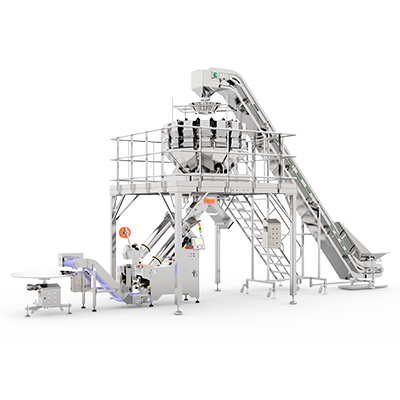
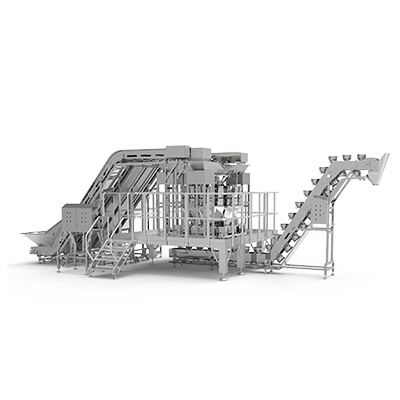
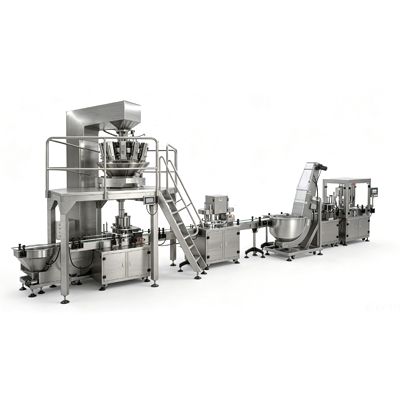
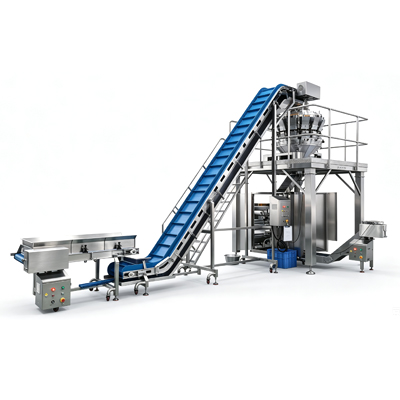
You are here:Home / Products / Weigher / Linear Weigher / Two-tier 4-Head Linear Weigher 0.5L High Precision | Mini Powder Granule Automatic Weighing Machine 5–100g
loading
Two-tier 4-Head Linear Weigher 0.5L High Precision | Mini Powder Granule Automatic Weighing Machine 5–100g
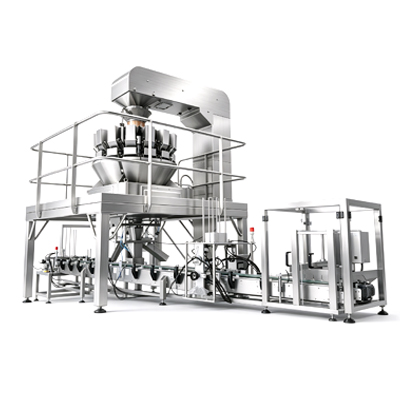
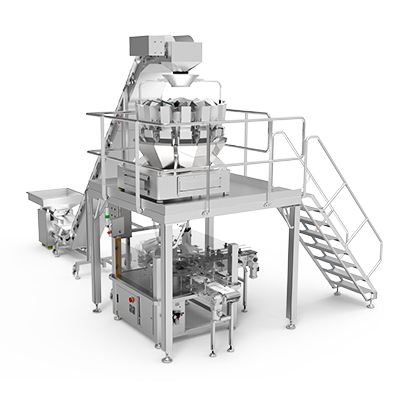
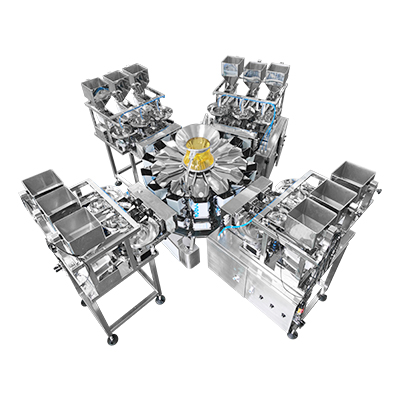
Two-tier four-head linear weigher with 0.5L tiny independent hoppers, ±0.2g ultra-high precision, max speed 30bpm, MCU + 7/10 inch touch HMI. Designed for micro-dose powder, seasoning, seeds, coffee, salt small sachet packing, free sample weighing test available.
Two-Tier 4-Head Linear Weigher (0.5L) — High Accuracy Dosing Engineered for High-Value Small Sachets
On a 5-gram stick pack, a 0.3g over-fill is 6% of the product you give away for free — multiplied by millions of packs, that rounding error becomes a six-figure line item. And if your scale can't hold ±0.2g, the premium SKUs that would pay for this machine never reach your line in the first place.
Industry Pain Points
The Four Costs That Only Show Up on Small-Dose Lines
Big-bag weighers and small-sachet weighers fail in completely different ways. If you run stick packs, sample sachets or micro-dose pouches, these are the leaks your current single- or double-head scale is hiding:
The Micro-Dose Giveaway Multiplier — Over-filling a 1 kg bag by 2g is noise. Over-filling a 5g sachet by 0.3g is a 6% margin hit per pack. At 30 bpm across two shifts, that invisible drift quietly eats a profit line you never see on a spreadsheet.
The High-Value Order You Can't Accept — Nutraceutical, premium coffee and infant-formula buyers specify tight weight tolerances in the contract. A scale that wanders outside ±0.2g doesn't just waste product — it locks you out of the highest-margin tenders entirely.
⏱️ The Sachet-Line Speed Ceiling — Your stick-pack machine is rated for 30+ packs a minute, but a single slow weighing head starves it. The packer idles, your OEE drops, and the bottleneck is the one component nobody budgeted to upgrade.
️ Fine-Powder Bridging on Tiny Doses — Coffee, milk powder and seasoning dust bridge and flush unpredictably. On a 100g dose you absorb the surge; on an 8g dose that same surge is a rejected pack — and a frustrated operator chasing a target that keeps moving.
If you are weighing up what is the best linear weigher for 5-100g small sachets, the honest answer is: not a scaled-down big-bag machine, but a head-count and feed-architecture built for the physics of small doses. That architecture is below.
The Solution
Four Heads. Two Tiers of Feed. One Machine That Makes Small Doses Profitable Again.
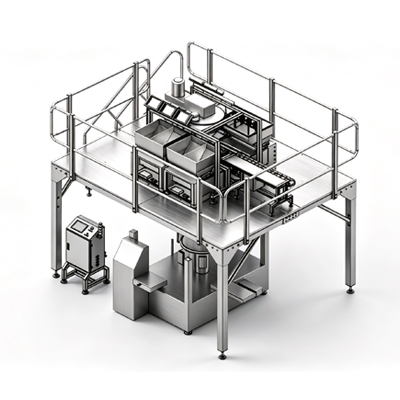
The Two-tier 4-Head Linear Weigher (0.5L) (Model TY-ZX042M05-07-11) is not a compromise unit — it is purpose-built around the math and the physics of micro-dosing. Every design choice answers one of the four leaks above:
Head count → speed: four independent weighing channels run in staggered cycles, sustaining a true 30 bpm so the weigher feeds the packer instead of throttling it.
Two-tier feed → stability: a coarse upper tier and a fine lower tier of vibration trays pre-settle the product, killing the surge that wrecks small-dose repeatability — especially on powders.
Resolution → revenue: a 0.01g minimum interval inside a ±0.2g accuracy envelope lets you set the target at the legal floor with confidence, so the giveaway multiplier goes to (near) zero.
Small hopper → agility: 0.5L contact volumes mean minimal residue between SKUs, so a 100-SKU seasoning range changes over in minutes, not in lost production hours.
The payoff is a small-dose line whose cost-per-sachet you can finally model — and whose premium-SKU pipeline you can finally say yes to. Whether you are sourcing a small dose linear weigher factory for a new line or retrofitting a choking station, this is the module that moves the bottleneck.
Core Advantages
️Advantage 1 — 30 bpm Without Sacrificing Small-Dose Stability
Feature: Four parallel weighing heads fed by a two-tier vibration system — a coarse feed tier for bulk fill and a dribble tier for the final grams.
Advantage: While two heads discharge, the other two are already topping up, so the line holds a continuous 30 bpm cadence and the two-tier dribble removes the over-shoot that single-tier feeders cause on tiny targets.
Benefit: You get the throughput of a much larger machine on a footprint that fits above a stick-pack station — the direct answer for anyone asking which linear weigher suits high-speed stick pack lines. No more idling packer, no more "we'll run it slower."
Advantage 2 — 0.01g Resolution That Turns Accuracy Into a Sales Tool
Feature: High-sensitivity load cells delivering a 0.01g minimum scale interval across the 5–100g range, held within a ±0.2g accuracy band — a genuine 0.01g resolution linear weigher for high value powder.
Advantage: Tight, repeatable distribution means the safety margin you add above the legal minimum can shrink from "a few grams of hope" to a fraction of a gram. On a 5g pack, that recovered fraction is enormous in percentage terms.
Benefit: Two revenue effects at once — the micro-dose giveaway multiplier collapses, and you can sign the tight-tolerance contracts (premium coffee, nutraceuticals, formula) that previously walked to a competitor. As a ±0.2g accuracy linear weigher for seasoning sachet workhorse, it pays for itself on the SKUs it lets you win.
Advantage 3 — A 0.5L Hopper Built for 100-SKU Changeovers
Feature: Compact 0.5L stainless contact volumes with quick-release, tool-free trays — a 0.5L hopper linear weigher for milk powder sachet and every other fast-switching small line.
Advantage: Small internal volume means almost no product is trapped between runs; a flavour or formula change is a two-minute strip-and-wipe, not a 30-minute purge.
Benefit: High-mix, low-volume small-pack production stops being a cost centre. You can profitably run short batches of a long SKU list — the exact model modern retail and e-commerce demand — without the changeover downtime that usually kills it.
Advantage 4 — One Operator, Four Heads, Zero Micro-Dose Guesswork
Feature: An industrial MCU control system with per-head tuning and a 100+ recipe library, presented on a 7"/10" touch screen HMI.
Advantage: Each head's feed amplitude is stored per recipe and recalled in one tap, so a small-dose target is hit by the controller — not by an operator manually chasing a drifting number on a 5g pack.
Benefit: Human error, the single biggest source of small-dose variation, is engineered out. One operator comfortably runs the multi-head station across frequent changeovers, labour cost per sachet falls, and every batch carries a traceable weight record. Wondering how accurate is a four head linear weigher for powder in real production? This closed-loop, recipe-locked control is the reason the lab spec survives the factory floor.
Application Scenarios
Small granular and powder products — sugar, rice, chicken essence, seeds, salt, milk powder, coffee, seasoning — dosed into stick packs, sample sachets and micro pouches. This is high precision linear weigher supplier-grade repeatability at small-dose scale.
️ ️ Scenario 1 — Seasoning & Chicken-Essence Stick Packs A condiment line running single-serve seasoning and chicken-essence sticks at 30 bpm needs every 8g pack identical — retail multi-packs expose any short or heavy stick instantly. As a four head linear weigher for small sachet packaging, the staggered four-head cycle keeps the packer fed while the two-tier dribble holds each micro-dose inside spec, shift after shift.
☕ Scenario 2 — Premium Coffee & Milk-Powder Micro-Sachets Fine, aerated coffee and milk powder are exactly the materials that bridge and flush — and exactly the high-value SKUs where a 0.3g error hurts most. Here the unit earns its keep as a two-tier vibration feed linear weigher for fine powder and a high accuracy linear weigher for nutraceutical powder dosing: the coarse/fine feed tames the surge, the 0.01g resolution protects the margin, and the tight tolerance unlocks the premium contracts.
Scenario 3 — Seed, Salt, Sugar & Rice Sample Pouches Free-flowing seeds, salt, sugar and rice into trial-size and portion pouches demand speed more than anything — volume is the business model. Mounted above a multi-lane pouch filler, it runs as a four head linear weigher for seed and salt small bag and a compact 4-head linear weigher for sugar and rice sachet, the four heads doubling effective cadence so the small-pouch line never waits on the scale. Still deciding can a two-tier linear weigher handle both granules and fine powder on the same platform? This scenario set is the proof — one architecture, both material families.
Technical Specifications
Grouped the way a small-dose buyer actually evaluates: dosing performance first, then control and the footprint that has to fit your line. (Note: this model sheet specifies dosing, control and packing envelope; electrical supply is configured to your local grid at order — see Trust section.)
Identity & Small-Dose Performance
Parameter
Value
Model
TY-ZX042M05-07-11
Weighing Range
5 – 100 g
Accuracy
±0.2 g
Minimum Scale Interval
0.01 g
Maximum Speed
30 bpm
Hopper Volume
0.5 L
Control & Form Factor
Parameter
Value
Control System
Industrial MCU (per-head tuning)
HMI
7" / 10" colour touch screen
Packing Dimensions
1180 (L) × 780 (W) × 857 (H) mm
This is, in plain terms, a 5-100g small dose linear weigher for stick pack and sample-pouch work — and the four head linear weigher price for 30bpm coffee stick pack enquiries we quote most often lands right in this spec window.
Quality & After-Sales (Trust)
Certified to Export. Hygienic by Design. Backed Wherever You Run.
Certified — CE & ISO. Built and tested by an established 0.5L high accuracy linear weigher manufacturer to CE and ISO standards, with documentation that clears EU, North American and GCC customs without delay.
Hygienic — food-grade throughout. All product-contact surfaces in SUS304 / 316 stainless steel with rounded, weld-free corners, so fine powder and granules have nowhere to hide between SKUs.
Guaranteed — 1-year warranty, real parts support. A documented wear-parts schedule ships with every unit, and stocked spares dispatch within 48 hours — because on a 30 bpm line, a worn feed tray cannot become a week of silence.
Supported — commissioned remotely, integrated locally. We pre-tune feed parameters to your product on video, supply integration drawings for your stick-pack or pouch machine, and configure the electrical supply to your local voltage at order — so the question where to buy a 0.01g high accuracy linear weigher ends with a machine that runs on your grid, on your floor, on day one.
FAQ
Q1 — How many heads do I actually need to hit 30 bpm on small bags?
It comes down to your pack weight, your product's flow, and the cycle time your packer demands. As a rule of thumb, a single head tops out well below 30 bpm on a stable small dose; two heads get you close but leave no margin for changeovers or a sticky batch; four heads give you the staggered overlap that holds 30 bpm comfortably with reserve. That is exactly why this platform is a four-head design — and why how many heads do I need for 30bpm small bag packaging is the first question we model for you, free, before you order. Send us your target weight and packer speed and we return a head-count recommendation with the maths shown.
Q2 — Will the two-tier feed really handle both free-flowing granules and fine, bridging powder?
Yes — that is the entire point of the two-tier architecture. The upper tier moves bulk product quickly (ideal for granules like seeds, salt, sugar and rice), while the lower dribble tier meters the final grams with the gentle, controlled feed that fine powders like coffee, milk powder and seasoning need to stop bridging and flushing. So can a two-tier linear weigher handle both granules and fine powder on one machine? In practice it is the configuration we recommend precisely because your SKU list contains both. We tune the per-head vibration profile to each material and save it as a recipe, so switching families is a tap, not a re-engineering job.
Q3 — Can you customise the 5–100g range, the recipe library and the voltage for my market?
All three, yes. The 5–100g window is the standard envelope, but we tailor the feed trays, hopper finish and load-cell setup to your actual smallest and largest SKU — tell us the two extremes and we build to them. The MCU recipe library holds 100+ products for high-mix lines, and the electrical supply is configured to your local voltage and frequency at order (the model sheet lists the dosing and control spec; power is matched to your grid, not fixed). The result is a small dose linear weigher factory build that arrives ready for your products, your SKUs and your sockets — and the four head linear weigher price for 30bpm coffee stick pack quote you receive reflects exactly that configuration, not a generic list figure.
Send Us Your Smallest, Hardest SKU. We'll Prove the 0.01g on Camera.
Small doses are where weighers lie in the brochure and tell the truth on the floor. So don't take the spec sheet's word for it — send us the product that gives you the most trouble at the lowest weight, and we will run it, film the repeatability, and return a four-head configuration tuned to your line.
[Get a Free Small-SKU Dosing Test & 30 bpm Line Quote] [Request a Stick-Pack / Pouch Integration Drawing] [Talk to a Small-Dose Weighing Engineer — Reply Within 24h]
No obligation. No catalogue price. Just a high-accuracy small-dose solution engineered around the pack that matters most to your margin.
Disclaimer: Machine renderings, engineering dimension drawings and all technical parameters displayed on this page are for reference purposes only. Please consult our professional sales engineer to confirm customized specifications matching your powder fineness, four-spec mixed micro-packing layout and hourly high-volume micro-sachet throughput demands.
Product Description
Submit Your Requirements
Please submit your requirement form, and we will customize the most suitable solution according to your needs.
Automated mesh bagging extends produce shelf life by providing vital airflow. Upgrading your line slashes labor costs, stops product giveaway, and maximizes daily output.
Dust-controlled powder fillers use vacuum extraction and servo-driven augers to package fine materials. These automated systems prevent waste, ensure safety, and maximize ROI.
Horizontal packaging machines use lateral movement to safely package solids, powders, and liquids. These systems ensure leak-proof seals, cut labor costs, and maximize your ROI.
It is a high-tech enterprise specializing in the R&D, design, and independent manufacturing of packaging, conveying, weight detection, weighing, and filling equipment.