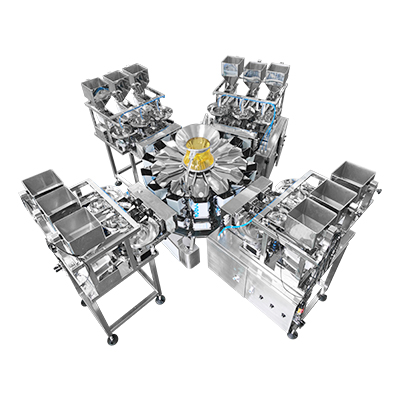
You are here:Home / Products / Weigher / Linear Weigher / 4-Head Screw Linear Weigher 0.5L Small Hopper | Fine Powder Screw Feeding Weighing Machine 5–500g High Precision
loading
4-Head Screw Linear Weigher 0.5L Small Hopper | Fine Powder Screw Feeding Weighing Machine 5–500g High Precision
4-head screw linear weigher equipped with 0.5L small hoppers, screw forced feeding design for free-flow fine powder, X(0.5) precision, max speed 50bpm, PLC + 7/10 inch touch HMI. Ideal for flour, spice powder, chicken essence small pouch quantitative weighing, free material test available.
4-Head Screw Linear Weigher (0.5L) — The Servo-Auger Powder Specialist That Holds 50bpm on 5–500g Sachets
A vibratory tray makes fine powder fly, wait and overshoot — so your line dusts product into the room, stalls at 25bpm and gives 2–4% of every high-value dose away. Positive displacement doesn't. Four servo-driven augers meter powder like syringes: dust inside the machine, X(0.5) at the 5g dose, and a PLC your electrician already speaks.
Industry Pain Points
The Four Leaks Draining Every Powder Sachet Line
If you pack 5–500g sachets of flour, spice, seasoning, milk powder or industrial powder, your P&L is not losing money in one big hole — it is losing it in four small leaks that a vibratory-fed line cannot seal. Your production planner knows all four by heart:
️ The Dust Leak — On a vibrating tray, fine powder does not pour, it aerosolises: a fraction of every dose ends up on the guard, the floor and the filter instead of in the bag. Multiply that by 50 cycles a minute and you have product loss, allergen cross-contamination between SKUs, a hygiene-audit finding, and operators breathing your margin.
The Cadence Leak — Aerated powder needs settle time before a vibratory head can trust its own reading, and when it finally flows it overshoots — so vibratory powder lines stall at 20–30bpm while your sachet target sits at 50. This is exactly the doubt behind screw feeder or vibratory linear weigher for powder — and on fine powder, vibration is the leak.
The Giveaway Leak — At a 5–50g dose, a ±1–2g vibratory overshoot on milk powder or spice is 2–4% of the bag given away for free. Per shift, that is kilograms of your most expensive ingredient donated to the landfill — a quiet tax no QC report ever names.
The Integration Leak — A microcontroller black box exposes no I/O your line integrator recognises and no ladder logic your electrician can troubleshoot, so the weigher never truly handshakes with the sachet VFFS, and every fault waits on a vendor remote session across a time zone.
A fifth, quieter leak: the changeover. A vibratory tray with seams and corners takes an hour to strip and wipe between allergen SKUs — an hour your 50bpm target never budgeted for.
The Solution
Positive Displacement Plugs All Four Leaks. The Screw Turns, the Dose Moves — No Awaiting, No Aerosol, No Overshoot.
The 4-Head Screw Linear Weigher (0.5L) is built on one physical truth about powder: powder does not want to fall reliably — it wants to be metered. So instead of shaking powder off a tray and hoping it settles, this auger powder weighing machine drives it with four independent servo-controlled screw axes, and every leak above gets a mechanical plug:
Servo augers → the cadence leak, plugged: a turning screw displaces a fixed volume per revolution, so there is no settle time and no aerosol to wait out — the dose moves when the servo says it moves. Four axes sharing the work sustain 50bpm on real powder sachets, not on a demo granule. (And yes — a single auger metering five kilos is the crawl you have heard about; four servo augers sharing a 50g sachet dose are a different animal entirely.)
Two-stage screw dosing → the giveaway leak, plugged: a fast-fill stage runs the dose to the last gram, then a servo top-off stage closes it in screw increments a vibratory burst can never make — which is how a micro powder filling scale holds X(0.5) with 0.5g resolution at the 5g dose.
Enclosed path + tool-less strip → the dust and changeover leaks, plugged: powder travels inside sealed tubes behind a clear acrylic guard and never sees open air until it is inside the bag; and because each auger screw and tube pulls out without tools, an allergen changeover is a minutes-long wipe, not an hour-long excavation.
PLC control → the integration leak, plugged: a plant-native PLC with exposed I/O handshakes with your sachet VFFS on day one, and your electrician troubleshoots ladder logic he already speaks — no vendor hostage, no black box.
The result is a powder sachet line whose OEE climbs from four directions at once: less product in the filter, a higher sustained cadence, giveaway returned to margin, and changeovers measured in minutes. The compact suspended body drops its 80mm outlet straight into a VFFS forming tube, so the install is a bolt-on, not a rebuild. One honest boundary, stated up front: this is a free-flowing powder weigher — non-sticky, good-fluidity materials only. If your powder bridges, we will tell you before you pay, not after.
Core Advantages
Four Servo Augers: 50bpm on Powder, Not on a Demo Granule
Feature: Four independent servo-driven auger axes, each feeding its own 0.5L weigh chute with two-stage fast-fill + top-off, sequenced by the PLC to sustain 50bpm across 5–500g — a 50bpm auger weigher for powder sachets.
Advantage: Positive displacement is immune to the two things that stall vibratory powder lines: aeration and settle time. The screw turns, the dose moves — no waiting for powder to calm down, no overshoot when it suddenly flows, and no single oversized screw because four axes share the workload.
Benefit: The 50bpm in your quote is the 50bpm on your flour or spice, shift after shift — while a vibratory line on the same powder stalls at 25. So screw feeder or vibratory linear weigher for powder? On free-flowing granules at a low budget, vibration is fine; on fine powder at a 50bpm target, positive displacement is the only architecture that does not leak cadence.
X(0.5) at the 5g Dose: The Giveaway Valve, Closed
Feature: X(0.5) accuracy class with 0.5g minimum scale interval and servo screw top-off, across the full 5–500g window — an X(0.5) accuracy micro powder weigher and a 5-500g powder weighing machine in one compact body.
Advantage: The top-off stage closes the final gram in controlled screw increments instead of vibratory bursts, and the 0.5g resolution actually sees a 5g dose — so the ±1–2g overshoot that bleeds 2–4% off every high-value bag simply stops happening.
Benefit: Milk powder and spice stop being donated to the landfill, retail weight compliance stops being a gamble, and the payback on the machine hides inside the giveaway you recover. Wondering how accurate is auger weighing at 5g powder doses? Honest arithmetic: within the X(0.5) class tolerance, resolved at 0.5g, closed by servo top-off — the dose a vibratory head can neither see nor land.
Dust Inside the Machine, Not in Your Room — Changeover in Minutes
Feature: Fully enclosed auger paths behind a clear acrylic dust guard, food-grade stainless contact surfaces, and tool-less removable screws and tubes at every dosing point — a dust-free screw powder filler.
Advantage: Powder never meets open air between the surge hopper and the bag, so there is nothing to aerosolise, nothing to settle on guards, and nothing to cross-contaminate; and when the SKU changes, each screw and tube pulls out, wipes and clicks back in without tools.
Benefit: Your hygiene audit loses its favourite finding, your operators stop breathing product, allergen SKUs can share a line, and changeover stops eating an hour per switch. Operators asking how fast is powder changeover on a 4 head auger weigher usually discover the answer the first time they strip one: four screws out, wipe, in — minutes, not the hour a seamed vibratory tray demands.
PLC Control and an 80mm Drop-In: Your Integrator's Favourite Machine
Feature: A plant-native PLC with exposed I/O and per-powder auger recipes on the 7-inch / 10-inch touch screen, in a compact suspended body whose central cone ends in an 80mm outlet — a PLC powder weighingmachine that bolts over your existing sachet VFFS.
Advantage: The PLC handshakes with the bagger's I/O on day one and your electrician troubleshoots ladder logic he already speaks; the 80mm outlet aligns with standard forming tubes so no fabricated chute is needed; and the four servo axes draw a published 2.5kW — the honest power cost of positive displacement, still an ordinary export circuit with no panel upgrade.
Benefit: Integration takes days instead of weeks, the install is a bolt-on instead of a rebuild, and maintenance never waits on a vendor remote across a time zone. That candour extends to the power line: 2.5kW is more than a single vibratory drive and less than a multihead — we publish it, you budget it, and the circuit you have already fits it.
Application Scenarios
Quantitative weighing of non-sticky, good-fluidity materials — flour, spice and seasoning powders, chicken essence, milk powder, bakelite powder and similar free-flowing powders and granules — dosed into 5–500g sachets, stick packs and cans at 50bpm. This is the 4 head screw linear weigher price for powder sachet line that a multihead cannot touch, on powders a vibratory line cannot hold.
Scenario 1 — Flour Micro-Packs & Spice Sachets at a Co-Packer A bakery-supply co-packer runs 100–500g flour micro-packs in the morning and 10–50g chili, cocoa and spice sachets after lunch — two dust profiles, one line. As a screw feeder weigher for flour and spice powder, the enclosed augers keep both powders inside the machine, the servo top-off lands a 20g spice sachet inside X(0.5) instead of ±2g, and the tool-less strip turns the lunch-time allergen changeover from an hour of tray excavation into a minutes-long wipe — so the line holds 50bpm on both SKUs and the hygiene audit loses its finding.
Scenario 2 — Chicken Essence, Seasoning & Milk-Powder Stick Packs 5–20g chicken-essence and seasoning sachets and 15–30g milk-powder stick packs are the highest-value doses in the building — and the ones where vibratory giveaway hurts most. Here the unit earns its keep as an auger scale for chicken essence and seasoning powder and a milk powder sachet auger weighing scale: the two-stage screw dosing closes a 15g milk-powder stick at 0.5g resolution, the yellow chicken-essence granules in the sample tray prove the augers also meter free-flowing granules without crushing them, and the giveaway that used to leave with every stick returns to the margin line where it belongs.
⚡ Scenario 3 — Bakelite & Industrial Powders: The Non-Food Door Bakelite (phenolic resin) powder for electrical moulding, plus abrasive and chemical powders, are packed in 50–500g cans and bags by manufacturers who have never been served by a food weigher catalogue. As a bakelite powder filling scale, the unit brings the same enclosed, dust-free positive displacement to the industrial floor — where operator exposure and housekeeping, not hygiene audits, are the pressure — dosing free-flowing resin powder at 50bpm with the dust sealed behind the guard and the PLC talking to the plant's existing control cabinet. One machine, two worlds: the same screw that fills a spice sachet fills a phenolic can.
Condiment Mini Pouch Manufacturing
Fine chili powder, compound spice powder, catering small-pack chicken essence, monosodium glutamate fine powder, edible salt micro powder
Bakery & Flour Small Retail Packing
Wheat flour, cake premix powder, cocoa powder, milk powder small trial sachets, baby supplementary food fine powder
Food Additive Micro-Dose Filling
Food pigment powder, flavor essence powder, sweetener fine powder, nutritional fortifier small bags
Beverage Instant Powder Processing
Instant coffee fine powder, matcha powder, fruit flavor beverage powder small retail pouches
Technical Specifications
Grouped the way a powder-sachet buyer actually evaluates: dosing and throughput first (because the mechanism, the range and the cadence are the product), then the accuracy-and-control block that decides whether QC and the integrator sign off, then the power-and-footprint block that decides your circuit and your install. The 2.5kW draw is stated honestly as the cost of four servo axes, and the mount as suspended with an 80mm outlet — not borrowed from a floor-standing or vibratory model.
In plain terms, this is the micro powder filling scale a 50bpm sachet line defaults to when the product is powder, the dose is 5–500g, the audit is strict, and the electrician wants a PLC — and it is also the machine that will tell you plainly when your powder is too sticky for any auger.
Quality & After-Sales
Certified, Enclosed, and Honest Enough to Refuse the Wrong Powder.
Certified — CE & ISO. Built and tested to CE and ISO standards with the documentation that clears EU, North American and GCC customs on the first pass — the paperwork a serious auger powder weigher manufacturer ships as standard.
Honest about material — we run your sample first. Send 2kg of your powder and we run it on a test auger. If it is free-flowing, we quote the recipe; if it is sticky or hygroscopic and will bridge in a screw tube, we say so before you pay and point you to the right feeder architecture. That refusal is why the quotes we do send get signed.
Hygienic & sealed — stainless where it touches, acrylic where you look. Product-contact surfaces in SUS304 / 316 stainless with weld-free, crevice-free paths; the clear acrylic guard keeps dust in and lets operators see the dose — no opening the machine to check it.
Guaranteed — 1-year warranty, 48-hour spares. A documented wear-parts schedule — auger screws, tube seals, servo drives — ships with every unit, and stocked spares dispatch within 48 hours, because on a 50bpm sachet line a worn screw cannot become a week of giveaway.
Supported — your electrician, not a vendor remote. The PLC program backup ships on USB with the machine, ladder logic is documented, and our engineers support your maintenance team over video — so troubleshooting happens in your language, your time zone, your shift.
Integrated — bolted over your bagger, matched to your socket. We confirm the 80mm outlet against your VFFS forming tube, return a mount drawing, and verify the 2.5kW load on your circuit — so the 4-head screw linear weigher arrives as a bolt-on, not a rebuild.
FAQ
Q1 — Screw feeder or vibratory linear weigher for powder — which one actually wins on my sachet line?
It depends on what you are feeding, and the honest answer splits cleanly. On free-flowing granules — rice, seeds, granulated seasoning — at a modest budget, a vibratory feeder is a perfectly good machine and we sell those too. On fine powder — flour, spice, milk powder, resin powder — vibration is the wrong physics: the tray aerosolises the powder (dust leak), aerated powder needs settle time (cadence leak, typically 20–30bpm), and the final burst overshoots (giveaway leak). A servo auger is positive displacement: the screw turns, a fixed volume moves, nothing aerosolises and nothing waits — which is how four augers hold 50bpm on powder where a vibratory head stalls at 25. The caveat people repeat about augers — "they're slow" — applies to a single auger metering five-kilo bags; four servo augers sharing 5–500g sachet doses are the opposite machine. So screw feeder or vibratory linear weigher for powder? On powder at a 50bpm target, the screw; on granules at a lower budget, the vibrator — and we will quote whichever is right for your product.
Q2 — Can a screw weigher handle sticky or hygroscopic powders, or will they bridge in the tube?
Straight answer: no — and anyone who quotes you one for a sticky powder is selling you a downtime schedule. A screw tube is a positive-displacement device, and sticky or hygroscopic material bridges and ratholes inside it, so the dose starves mid-cycle and the servo chases a phantom. This unit is engineered for non-sticky, good-fluidity powders and granules — flour, spice, milk powder, chicken essence, bakelite — and we keep it that way on purpose. What we do instead is run your 2kg sample on a test auger before quoting: if it flows, you get the recipe and the quote; if it bridges, you get a plain "no" and a pointer toward the right architecture (agitator-assisted or alternative feeding), free of charge. So can a screw weigher handle sticky or hygroscopic powder? Not this one, not honestly — and that honesty is exactly what protects your line from a machine that fails every Tuesday.
Q3 — How accurate is auger weighing at a 5g powder dose, and what about voltage, lead time and buying factory direct?
Three practical answers. First, accuracy: the unit holds X(0.5) class with 0.5g resolution, and the two-stage dose — fast-fill to the last gram, then servo top-off in screw increments — closes a 5g dose inside the class tolerance instead of the ±1–2g a vibratory burst leaves behind; that is the difference between giving away 2–4% of every bag and giving away none. Second, power and grid: the four servo axes draw 2.5kW on an AC220V / 110V ±10%, 50/60 Hz supply — the honest cost of positive displacement, still an ordinary export circuit with no panel upgrade. Third, lead time and source: standard configurations ship on a published lead time; a customised auger pitch for an unusual powder density, HMI language or outlet height adds a short, quoted extension — and the quote reflects exactly that configuration. If you are deciding where to buy a 4 head screw linear weigher factory direct, that direct quote — with your powder test result, the auger pitch, the power load and the lead time written in — is what you are asking for.
Send Us 2kg of Your Powder. We'll Run It on a Test Auger and Return Your Recipe, Your Cadence and Your Price in 24 Hours.
A powder sachet line does not need a faster vibrator or a bigger tray — it needs positive displacement that keeps the dust inside, a top-off that closes the 5g dose, a PLC your electrician speaks, and an outlet that drops onto the bagger you already own. So skip the generic list price. Send us your powder and your target and we will do the engineering.
[Get a Free Powder Dosing Test — Send 2kg, Get Your Auger Recipe] [Request the 80mm Drop-In Drawing + Changeover Spec Sheet] [Talk to an Engineer About Your Sticky-Powder Verdict — Reply Within 24h]
No obligation. No wrong-application sale. Just a servo-auger, 0.5L, 5–500g four-head solution matched to your powder, your sachet, your bagger and your socket — and the lead time to match.
Disclaimer: Machine renderings, engineering dimension drawings and all technical parameters displayed on this page are for reference purposes only. Please consult our professional sales engineer to confirm customized specifications matching your powder fineness, multi-spec mixed mini-sachet packing layout and hourly micro small-dose pouch throughput demands.
Product Description
Submit Your Requirements
Please submit your requirement form, and we will customize the most suitable solution according to your needs.
Automated mesh bagging extends produce shelf life by providing vital airflow. Upgrading your line slashes labor costs, stops product giveaway, and maximizes daily output.
Dust-controlled powder fillers use vacuum extraction and servo-driven augers to package fine materials. These automated systems prevent waste, ensure safety, and maximize ROI.
Horizontal packaging machines use lateral movement to safely package solids, powders, and liquids. These systems ensure leak-proof seals, cut labor costs, and maximize your ROI.
It is a high-tech enterprise specializing in the R&D, design, and independent manufacturing of packaging, conveying, weight detection, weighing, and filling equipment.