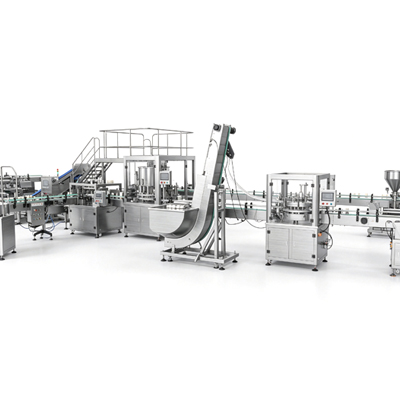
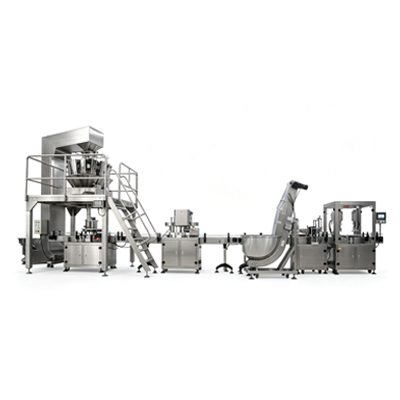
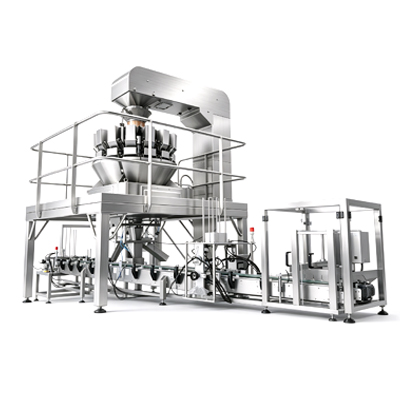
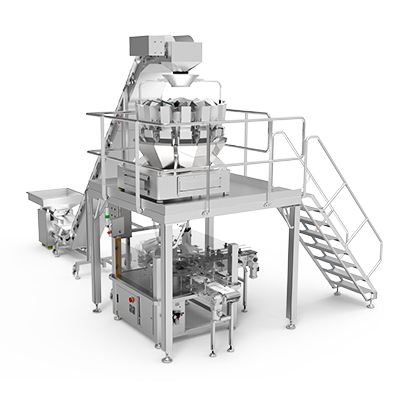
Automatic Rotary Volume Quantitative Filling Machine (LS-CSL Series) — 12,000 Bottles an Hour, Drift-Free to ±0.5%, on One Compact Carousel
Your gravity filler can't keep the line fed, your giveaway creeps past tolerance, and a single jammed bottle idles the whole plant. This carousel ends all three.
Industry Pain Points
Run the numbers on your current filler — do any of these ring true?
The throughput ceiling you can't break. Demand is climbing, but your inline filler tops out around 4,000 bottles/hour. Adding a second line means double the footprint, double the operators, double the headaches.
The giveaway that compounds silently. Gravity fill varies with head pressure and product level. You overfill by 5–8 ml "just to be safe" — and across millions of units, that's pallets of free product shipped every month.
The hot-fill headache. Sauces and condiments must go in hot to stay shelf-stable, but most fillers warp seals or lose accuracy above 60 °C. You're forced into costly cooling loops before filling.
The one-bottle-kills-the-line risk. On a serial conveyor, a tipped or mis-indexed bottle backs up everything downstream. One fault = the entire shift stalls while someone crawls under the guard.
The Solution
This is exactly where continuous rotary architecture beats every alternative. Buyers comparing options ask us: "rotary filling machine vs linear filling machine — which is better?" The rule of thumb we give plant engineers: if you run high volume on a stable SKU set and need to clear 5,000+ bottles/hour, rotary wins on speed-per-square-meter and per-unit cost. Linear suits frequent changeovers; rotary suits relentless output.
The LS-CSL series is a high speed rotary liquid filling machine built on a synchronized indexing carousel: bottles are positively gripped, lifted into each valve, filled volumetrically, then released — dozens of fills happening at the same instant. That parallelism is what pushes a single frame to 12,000 bottles/hour without stretching the footprint.
And because every fill is metered by a precision volumetric chamber — not by gravity or timed flow — accuracy locks at ≤±0.5% FV regardless of tank level or line speed. Less giveaway, no cooling loop, and a fault-isolated carousel that keeps running even if one station hiccups. That's OEE you can finally move upward.
Core Advantages
1. Parallel Rotary Throughput — 12,000 b/h on One Frame
Advantage: Dozens of simultaneous volumetric fills instead of one-at-a-time serial filling.
Benefit: Clear 5,500 → 12,000 bottles/hour on a single machine, deferring a second line's capex and floor space. (Direct answer to "what filling machine can reach 12000 bottles per hour.")
2. Volumetric Dosing at ≤±0.5% FV — Giveaway Eliminated
Feature: Precision metering chambers dose by fixed volume, independent of head pressure and tank level.
Advantage: Holds ≤±0.5% FV across the full 0.1–2.0 L range, at any line speed.
Benefit: Reclaim the 5–8 ml safety overfill. On a 12,000 b/h line, that's hundreds of liters of product recovered daily — the machine funds itself fast. (See "how accurate is a rotary volumetric filling machine.")
3. Hot-Fill Ready, 8–90 °C — Skip the Cooling Loop
Feature: Heat-tolerant seals and valve bodies rated for product temperatures from 8 to 90 °C.
Advantage: Fill sauces and condiments hot, direct from the kettle, with accuracy intact.
Benefit: Delete the pre-fill chiller and its energy bill; preserve shelf life and cut process steps. (Our standard build for a "hot fill rotary filling machine for sauces and condiments.")
4. Viscosity-Tolerant & Fault-Isolated — Uptime You Can Schedule
Feature: 7–370 mm² (at 50 °C) viscosity window; mechanically isolated filling stations on the carousel.
Advantage: Handles detergents, lotions, and oils smoothly; one mis-indexed bottle doesn't stall the line.
Benefit: Fewer jams, fewer emergency stops, predictable shift output. (Yes — to "can a rotary filling machine handle viscous liquids like detergent," within spec it absolutely does.)
Application Scenarios
Scene 1 — Edible Oil & Condiments at Scale. A 24-valve carousel runs as a rotary filling machine for edible oil bottles, clearing 500 ml PET at 12,000 b/h with golden fills dead-level to the mark. Downstream the same platform becomes a hot fill rotary filling machine for sauces and condiments, taking chili sauce straight from the cook kettle at 85 °C — no chiller, no accuracy loss, label-ready out of the filler.
Scene 2 — Detergents, Cosmetics & Personal Care. Configured for mid-viscosity fluids, the line serves as a high speed rotary filling machine for detergent liquids, dosing laundry and dish soap cleanly into HDPE; retooled for gentler handling, it becomes a rotary filling machine for cosmetic lotion and liquid soap, filling frosted pump bottles at 8,000 b/h without foaming or shear damage to the emulsion.
Scene 3 — Agrochemicals, Medical & Petroleum. Corrosion-resistant wetted parts let the carousel operate as a rotary filling machine for pesticide and agrochemical liquids under sealed, ventilated guarding; with sanitary-grade contact surfaces it fills medical disinfectant and sanitizer for healthcare supply contracts; and tuned for hydrocarbons, it runs as a rotary filling machine for petroleum products and engine oil, metering lubricants into rigid containers at consistent weight.
Technical Specifications
Parameter
LS-CSL-12/G-5500-V01
LS-CSL-18/G-8000-V01
LS-CSL-24/G-12000-V01
Filling Valves
12 sets
18 sets
24 sets
Speed (500 ml)
5,500 b/h
8,000 b/h
12,000 b/h
Power
≈1.5 kW
≈2.5 kW
≈3 kW
Filling Capacity
0.1 – 1.0 L
0.1 – 2.0 L
0.1 – 2.0 L
Filling Accuracy
≤±0.5% FV
≤±0.5% FV
≤±0.5% FV
Filling Temperature
8 – 90 °C
8 – 90 °C
8 – 90 °C
Filling Viscosity
7 – 370 mm² (50 °C)
7 – 370 mm² (50 °C)
7 – 370 mm² (50 °C)
Air Pressure / Consumption
0.4–0.6 MPa · 0.1 m³/h
0.4–0.6 MPa · 0.1 m³/h
0.4–0.6 MPa · 0.1 m³/h
Power Supply
3-phase 380V, 50Hz
3-phase 380V, 50Hz
3-phase 380V, 50Hz
Pipe Diameters (Feed/Air/Drain)
50 / 10 / 25 mm
50 / 10 / 25 mm
50 / 10 / 25 mm
Dimensions (mm)
1510×1700×2300
2000×2100×2500
2000×2370×2700
Weight
1,500 kg
2,200 kg
2,500 kg
Choosing between models? See our guide on how to choose rotary filling machine head count — 12, 18, or 24 below, or let our engineers size it to your target b/h.
Quality & After-Sales
Sourcing from a direct automatic rotary filling machine manufacturer — not a reseller — means engineered-to-order pricing backed by real application know-how. As a rotary volumetric filling machine supplier and rotary filling machine factory in China for 0.1–2L bottles, we guarantee the whole asset:
CE & ISO 9001 certified; SUS304/316L product-contact parts, seal material matched to your fluid (food, chemical, or hydrocarbon grade).
12-month warranty + lifetime technical support.
Free wear-part starter kit (seals, gaskets, valve rings) ships with every carousel;
Price scales with valve count (12/18/24), wetted-part material, and hot-fill options. As the manufacturer we issue a FOB quote within 24 hours — no distributor margin. Request the rotary volumetric filling machine price sheet via the form below.
Q2: How to choose rotary filling machine head count — 12, 18, or 24?
Match valves to target output at your bottle size: 12 valves ≈ 5,500 b/h, 18 ≈ 8,000 b/h, 24 ≈ 12,000 b/h (all at 500 ml). We add a 15–20% buffer so you're never running the carousel at its redline.
Q3: Can a rotary filling machine handle viscous liquids like detergent?
Yes, within the 7–370 mm² (at 50 °C) window — that covers most detergents, lotions, and oils. True pastes and greases exceed this; for those we recommend our piston-based linear line instead.
Q4: How accurate is a rotary volumetric filling machine over a long run?
≤±0.5% FV, sustained. Volumetric chambers dose a fixed volume per cycle, so accuracy doesn't drift as the supply tank empties or line speed changes — unlike gravity or time-fill methods.
Q5: Voltage compatibility, lead time, and spare parts?
Standard 3-phase 380V/50Hz; we rebuild electrics for 220–480V, 50/60Hz to suit your grid. Lead time 35–50 days depending on configuration; wear-part kit included and spares shipped within 48 hours for the machine's life.
Turn Throughput Into Margin — Without a Second Line
Send us three figures — target bottles/hour, fill volume, and product type. Within 24 hours you'll get: the right valve count (12/18/24), a footprint layout, the rotary volumetric filling machine price sheet, and lead time. This rotary filling machine for sale is configured to your line's real numbers — not a catalog guess.
[Get Free Customization Quote] · WhatsApp · Live Video Factory Tour
20 YEARS Focus on
Poviding intelligent weighing
and packaging solutions
Product Description
Submit Your Requirements
Please submit your requirement form, and we will customize the most suitable solution according to your needs.
Automated mesh bagging extends produce shelf life by providing vital airflow. Upgrading your line slashes labor costs, stops product giveaway, and maximizes daily output.
Dust-controlled powder fillers use vacuum extraction and servo-driven augers to package fine materials. These automated systems prevent waste, ensure safety, and maximize ROI.
Horizontal packaging machines use lateral movement to safely package solids, powders, and liquids. These systems ensure leak-proof seals, cut labor costs, and maximize your ROI.
It is a high-tech enterprise specializing in the R&D, design, and independent manufacturing of packaging, conveying, weight detection, weighing, and filling equipment.