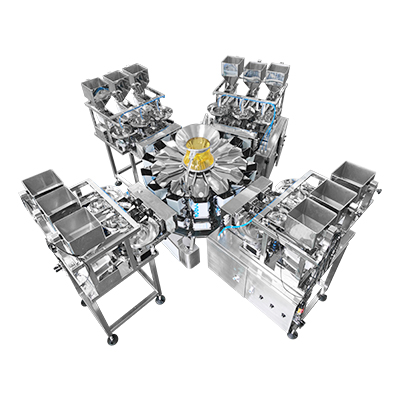
B25/B60 Vision Counting Machine | High-Speed Linear-CCD Optical Parts Counter
Stop guessing quantity by weight — count it by sight. The B25/B60 vision counting machine uses a high-speed linear CCD sensor and a large-capacity FPGA chip to image and count every piece in real time at up to 12,000 pcs/min with ≤3% counting error. A quasi-desktop, compact optical counter for seeds, grains, plastic parts, fasteners and electronic terminals — accurate where scales fail on tiny, light or variable-weight items.
B25/B60 Vision Counting Machine | High-Speed Linear-CCD Optical Parts Counter
Counting small things is one of those tasks that looks trivial and quietly ruins a packing line. Weigh a handful of screws and divide by the average piece weight, and you are betting that every screw weighs the same — which they never quite do, especially once plating, oil, moisture or a fraction of a millimetre of thread varies. Count by hand and you are slow, tired and wrong by lunchtime. The B25/B60 Vision Counting Machine sidesteps both traps by refusing to estimate at all: it images every individual piece as it passes and counts it directly. A high-speed linear CCD sensor watches the curtain of parts falling (or sliding) through the imaging window, capturing them row by row, while a large-capacity FPGA chip processes that image stream in real time — detecting edges, separating touching silhouettes and incrementing the tally on the fly. There is no averaging, no assumed piece weight and no human in the loop; the number on the display is the number of objects the camera actually saw.
This is the second generation of the platform, and the generational jump shows exactly where it matters — at speed. The linear-CCD-plus-FPGA pairing lets the B25 sustain around 9,000 pieces per minute (bpm) and the B60 push to 12,000 bpm, while holding counting error to ≤3% across the run. Those figures are not a laboratory best case; they are what the optical path and the parallel hardware processing are built to deliver continuously, because the FPGA does the image math in dedicated logic instead of queuing it behind a general-purpose CPU that would stall under a 200-piece-per-second stream. The result is a counter that stays accurate because it is fast, not in spite of it.
Equally important is the form factor. The B25/B60 is a quasi-desktop counting device — a deliberate design choice. The hopper, vibratory feed, optical head, control cabinet and discharge table are folded into a compact structure roughly a metre long and half a metre wide (≈972 × 550 × 853 mm, ~110–112 kg), so the unit sits on a bench, tucks into a corner or bolts into a line without demanding a dedicated room. Power draw is a modest 0.75 kW on standard AC 220 V, and the only pneumatic need is a clean 0.5–0.9 MPa supply for the discharge gate. In other words it is a high-throughput optical counter that behaves like a piece of benchtop equipment: reasonable design, convenient use, low running cost, and a counting efficiency that manual labour or a weigh-based guess simply cannot match — particularly on the tiny, light, oily or irregular parts where weighing is at its weakest and vision counting is at its strongest.
Application Industries
Wherever products are small, numerous and must be packed by quantity rather than by weight — and especially where the pieces are too light or too variable for a scale to count reliably — this optical counter replaces manual counting and weigh-estimation:
Seed, Grain & Agriculture
Counting and bagging of adzuki beans, soybeans, maize, rice, vegetable and flower seeds by exact seed count per pack, where germination-grade packs are sold by number, not grams.
Hardware & Fasteners
High-speed counting of screws, nuts, bolts, washers, rivets and pins into bags or boxes; the optical method ignores the plating/oil weight variation that breaks weigh-counting on fasteners.
Plastic & Rubber Components
Counting injection-moulded parts, O-rings, gaskets, caps, rings and fittings for kit-packing, where pieces are light and a scale’s resolution is too coarse to count them.
Electrical & Electronic Parts
Counting wire ferrules, terminals, connectors, pins and small PCB components into reels, tubes or bags, where mix-ups and short counts are costly.
Food Grains, Beans, Nuts & Snacks
Portioning of beans, nuts, candies, coffee beans and snack pieces into retail packs by count for consistent “pieces-per-pack” labelling.
Pharma, Nutraceutical & Healthcare (extension)
Counting of tablets, capsules, softgels and small medical components where a verified piece count per bottle is a regulatory and patient-safety requirement (contact surfaces specified to suit).
Industry Pain Points & Professional Solutions
The failures this optical counter prevents are not the failures of a metal detector or a checkweigher — they are the failures of trying to count by weight or by hand. Each problem below is presented as what you observe, why the old method breaks, and how linear-CCD vision counting resolves it.
Pain #1 — “The pack count is wrong even though the pack weight is ‘right’.” What you see on the floor: bags labelled “100 pcs” that actually hold 97 or 103, because the line weighed the bag and divided by an average piece weight. Why scales and hands fail here: natural and machined parts vary in individual mass — moisture, plating thickness, flash, oil — so a fixed average piece weight drifts, and the error multiplies with every piece in the pack.
How linear-CCD vision counting fixes it:the camera counts discrete objects, not mass, so the 100th piece is the 100th object the FPGA saw — independent of how heavy or light any single piece happens to be.
Pain #2 — “The parts are too light for the scale to count.” What you see on the floor: tiny rings, pins or seeds whose single-piece weight is near or below the scale’s readable division, so weigh-counting produces wild scatter. Why scales and hands fail here: a scale resolves weight, not number; when one piece weighs a fraction of a gram, the resolution and the tare noise swamp the count.
How linear-CCD vision counting fixes it:optical counting needs only that the piece casts a visible silhouette, not that it has measurable weight — so the lighter the part, the more vision outperforms weighing.
Pain #3 — “We cannot keep up with the line by counting by hand.” What you see on the floor: operators counting into trays with clickers, slowing the line, tiring, and drifting in accuracy across a shift. Why scales and hands fail here: human counting is slow, inconsistent and a contamination risk on food and pharma goods.
How linear-CCD vision counting fixes it:the B60 sustains ~12,000 bpm with no fatigue and no hands on the product, fixing throughput at a constant, repeatable rate.
Pain #4 — “Touching or overlapping parts get miscounted.” What you see on the floor: two pieces counted as one (or one split into two) when they fall together, inflating the error. Why scales and hands fail here: a simple photoelectric beam sees a clump as one block; a person misses clumps at speed.
How linear-CCD vision counting fixes it:the vibratory chute singulates the stream and the FPGA image algorithm separates touching silhouettes by shape, so clumps are resolved into individual counts rather than guessed.
Pain #5 — “The machine is too big and too power-hungry for our space.” What you see on the floor: counting stations that need their own footprint, heavy power feeds and awkward integration. Why scales and hands fail here: bulky counters waste floor space and complicate line layout. How linear-CCD vision counting fixes it:the quasi-desktop, compact body (~972 × 550 × 853 mm, ~110–112 kg) and a low 0.75 kW draw let it sit on a bench or slot into a tight line without re-engineering the room.
Pain #6 — “Changeovers between products take too long.” What you see on the floor: long re-tuning every time the part size or shape changes, killing OEE on multi-SKU lines. Why scales and hands fail here: weigh-counting needs a fresh, accurate average piece weight per SKU; manual setups are slow. How linear-CCD vision counting fixes it:the optical recipe (size/shape thresholds) is stored and recalled per product, so switching from beans to screws to ferrules is a recipe change, not a mechanical rebuild.
Core Product Features & Technical Advantages
High-Speed Linear CCD Image Acquisition
A linear (line-scan) CCD sensor captures the falling or sliding product stream one scan-row at a time, building a continuous, distortion-controlled image of every piece — the optical foundation that makes per-piece counting possible at high flow rates.
Large-Capacity FPGA Real-Time Processing
A dedicated FPGA performs edge detection, silhouette separation and tallying in parallel hardware logic, so image processing never queues behind a CPU and never drops pieces even at the B60’s 12,000 bpm.
Up to 12,000 pcs/min Counting Efficiency (B60) / 9,000 (B25)
Two throughput tiers let you match the counter to the line: the B25 at ~9,000 bpm for standard lines, the B60 at ~12,000 bpm for high-speed packing — both sustained, not peak-only.
≤3% Counting Error
A tight, specified counting-error band that holds across the run because the count is read from actual objects seen, not estimated from an average weight that drifts.
Quasi-Desktop Compact Structure
A benchtop-friendly, integrated body (hopper + feeder + optics + cabinet + discharge) in roughly a 972 × 550 × 853 mm envelope, designed for convenient use and easy placement in space-limited lines.
Vibratory Singulation Feed
A vibratory hopper and chute present parts in a controlled, separated stream to the imaging window, reducing clumps so the optics see individuals, not blocks.
Pneumatic Count-Based Discharge Gate
A fast pneumatic gate (0.5–0.9 MPa) snaps the batch off the instant the target count is reached, delivering an exact quantity to the bag, bottle, box or downstream packer.
Low Power & Simple Utilities
Only 0.75 kW on standard AC 220 V ±10% / 50 Hz, plus ≤1.0 m³/min of clean air — low running cost and easy to power on an ordinary line.
Wide Material & Shape Tolerance
The algorithm reads shape and silhouette, so the same optics count beans, grains, plastic rings, screws and wire ferrules — material-agnostic, from food to hardware to electronics.
Automatic Working Process
Bulk Loading — The product is poured into the top hopper, which buffers a supply of parts above the feed system.
Vibratory Feeding & Singulation — The vibratory chute meters the parts out and spreads them into a thin, separated stream, breaking up clumps before the imaging zone.
Linear-CCD Scanning — As the parts fall (or slide) through the imaging window, the high-speed linear CCD sensor scans them row by row, capturing a continuous image of the moving stream.
FPGA Real-Time Counting — The large-capacity FPGA processes each scan-line on the fly — detecting edges, separating touching silhouettes and incrementing the running tally with no CPU bottleneck.
Batch Accumulation & Compare — The live count is compared against the preset target quantity for the pack; the controller tracks how many pieces remain.
Count-Based Gate Cut-Off — The instant the target number is reached, the pneumatic discharge gate closes, releasing exactly that batch into the bag, bottle, box or downstream packer — no over- or under-count.
Reset & Continuous Cycle — The gate re-opens, the count resets to zero, and the next batch begins, sustaining the rated 9,000 / 12,000 bpm throughput batch after batch.
Technical Specifications
Parameter
B25
B60
Model
B25
B60
Counting Efficiency
9,000 bpm (pcs/min)
12,000 bpm (pcs/min)
Counting Error
≤3%
≤3%
Machine Power
0.75 kW
0.75 kW
Power Supply
AC 220 V ±10%, 50 Hz ±1%
AC 220 V ±10%, 50 Hz ±1%
Air Pressure
0.5 – 0.9 MPa
0.5 – 0.9 MPa
Air Consumption
≤1.0 m³/min
≤1.0 m³/min
Dimension (L×W×H)
972 × 550 × 853 mm
972 × 550 × 853 mm
Machine Weight
110 kg
112 kg
Sensor
High-speed linear CCD
High-speed linear CCD
Image Processing
Large-capacity FPGA (real-time)
Large-capacity FPGA (real-time)
Generation
Second-generation vision counter
Second-generation vision counter
Form Factor
Quasi-desktop, compact
Quasi-desktop, compact
The two models share the same compact footprint and utility needs; the B60 differs mainly in higher sustained counting throughput and slightly higher mass. Counting range, feed chute width, discharge interface and recipe library can be tailored to your part size, shape and target pack quantity.
FAQ
Q: How does a vision counter actually “count” — what is it measuring?
It is not measuring weight or length; it is counting objects in an image. The linear CCD captures the product stream as a continuous picture, and the FPGA finds each separate silhouette (each piece) in that picture and adds one to the tally. So the number you get is the number of distinct objects the camera saw passing the window.
Q: What does “9,000 / 12,000 bpm” mean, and is it sustainable?
bpm here is pieces (beads/parts) per minute — about 150 or 200 pieces every second for the B25 and B60 respectively. Because the image math runs in dedicated FPGA hardware rather than a queued CPU, these rates are sustained working throughput, not a momentary peak.
Q: You quote ≤3% counting error — what drives that error, and can it be lower?
The error band covers real-world effects like occasional touching parts, dust on the optics or unusual part orientation. On well-singulated, clean, consistent parts the achieved error is typically better than the ≤3% spec; the vibratory singulation and the recipe thresholds are exactly what push it down. We tune the recipe to your part during sampling.
Q: What happens when two pieces stick together or overlap?
That is the classic failure of a simple beam sensor, which sees a clump as one object. Here the vibratory chute first separates the stream, and the FPGA algorithm then splits touching silhouettes by shape analysis, so a clump is resolved into its individual pieces instead of being miscounted as one.
Q: What size and shape of part can it count?
The method needs the part to cast a clear silhouette at the imaging window — from small seeds and grains up to fasteners, plastic rings and wire ferrules. Very fine powders or fully transparent parts need special handling, but the typical range shown (beans, screws, rings, terminals) is exactly the sweet spot. We confirm limits with a sample test.
Q: What is the difference between the B25 and the B60?
Same compact footprint, same utilities, same optical principle — the B60 is the higher-throughput version (12,000 vs 9,000 bpm) with a marginally higher mass. Choose the B25 for standard lines and the B60 where the packer or upstream process demands the higher count rate.
Q: Why not just weigh the parts and divide by piece weight?
Because that only works if every piece weighs the same, and they don’t — plating, oil, moisture, flash and natural variation all shift the individual mass, so a weigh-count drifts, and it fails entirely when a single piece is near the scale’s resolution limit. Vision counting reads the number of objects directly, so it stays accurate exactly where weighing gets unreliable: tiny, light or variable-weight parts.
Q: What utilities and space does it need on site?
A standard AC 220 V ±10% / 50 Hz supply drawing only 0.75 kW, plus clean compressed air at 0.5–0.9 MPa (≤1.0 m³/min) for the discharge gate. The body is quasi-desktop at about 972 × 550 × 853 mm and ~110–112 kg, so it fits on a bench or into a tight line without a dedicated room.
Contact Us
Not sure whether your part will count cleanly, or whether the B25 or B60 matches your line speed? The fastest way to decide is a free counting sample test — send us your product and your target pack quantity, and we will run it on the optical counter and report the achieved count accuracy and throughput before you commit.
Product Description
Submit Your Requirements
Please submit your requirement form, and we will customize the most suitable solution according to your needs.
Automated mesh bagging extends produce shelf life by providing vital airflow. Upgrading your line slashes labor costs, stops product giveaway, and maximizes daily output.
Dust-controlled powder fillers use vacuum extraction and servo-driven augers to package fine materials. These automated systems prevent waste, ensure safety, and maximize ROI.
Horizontal packaging machines use lateral movement to safely package solids, powders, and liquids. These systems ensure leak-proof seals, cut labor costs, and maximize your ROI.
It is a high-tech enterprise specializing in the R&D, design, and independent manufacturing of packaging, conveying, weight detection, weighing, and filling equipment.