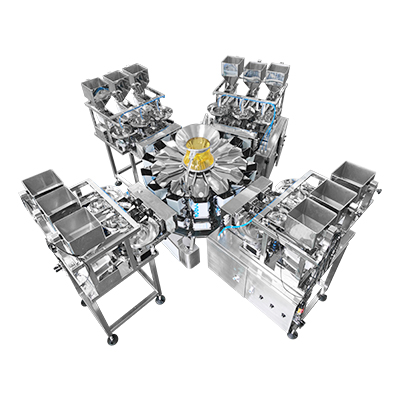
Horizontal Packaging Machine | Bag Feeding Pouch Line for Liquid, Powder & Large Pouches
The horizontal bag feeding packaging machine runs pre-made pouches up to 280×400 mm / 3000 ml at 30–60 bpm. Inline stations handle liquid, sauce, powder & granule on one narrow-footprint line. Get a layout & quote.
Horizontal Bag Feeding Packaging Machine | Inline Pouch Packing Line
Where a vertical or rotary line is built around speed, the horizontal packaging machine is built around freedom of format. The TY-280Z moves each pre-made pouch along a level, inline path—gripped, opened, filled and sealed by a row of fixed stations—so the product travels through the machine the same way it will later sit on the shelf: upright, settled and undisturbed. That horizontal motion path is the single design decision that lets one line accept small 90×110 mm sachets and family-size 280×400 mm doy packs on the same frame, with a fill volume ceiling of 3000 ml that vertical feeders struggle to reach.
As a horizontal pouch packing machine, it is equally at home with dry and wet products. The standard top-mounted dosing head handles powders and granules by auger or cup, while the inline layout leaves room to add a pump station, a settle station or a gas-flush station downstream—turning the same frame into a credible horizontal liquid packaging machine or paste line without re-engineering the chassis. This is the practical meaning of “multi-state filling”: the pouch is held horizontally and stationary at each tool, so liquid can be dosed in two calm stages, foam can settle, and powder dust can be cleared away before the seal jaws ever close.
For buyers running a horizontal premade pouch packaging machine for the first time, the headline benefit is not raw cycles per minute but cycles per format. The 30–60 bpm window is a deliberate, station-rich pace: it trades the blistering but format-rigid speed of a carousel for the ability to fill big bags, wet products and fragile laminates cleanly, shift after shift. On a single 1050 mm-wide frame, that versatility usually out-earns a faster but narrower machine.
Why the Horizontal, Inline Architecture Wins Here
It helps to be honest about what a horizontal line is not: it is not the fastest machine in the catalogue. What it is, is the most adaptable, and adaptability is where most packaging profit is quietly lost or won.
In a vertical machine the bag hangs and the product falls; in a rotary machine the bag spins through timed pockets. In the horizontal bag feeding packaging machine, the pouch is carried flat-to-upright along a straight transfer chain, and every operation happens at its own dedicated, stationary station. Because the stations sit side by side rather than stacked or rotated, you can add a station (a second fill head, an exhaust nozzle, a zipper press) or remove one as your product mix changes—without rebuilding the drive. The result is a line whose capability grows with your SKU list instead of fighting it.
The footprint tells the same story. At 4100 mm long but only 1050 mm wide, the TY-280Z slides into a narrow aisle where a rotary unit of equal capacity would not fit, and its low, linear profile keeps every station within arm’s reach of one operator. For plants paying rent by the square metre, that slim width is not a cosmetic detail—it is the difference between fitting the line in and knocking down a wall.
Application Industries
The inline layout and the swappable dosing heads make the TY-280Z a genuine multi-product workhorse across five broad categories:
Liquid & Sauce Foods
As a horizontal liquid packaging machine, it packs cooking oil, soy sauce, ketchup, chili paste, honey, juice concentrate and liquid seasonings, using staged filling so viscous products settle without foaming over the seal zone.
Powders & Fine Granules
Configured as a horizontal powder packing machine, it doses flour, milk powder, spice blends, coffee, protein powder and additive premixes, with dust extraction protecting the seal from contamination.
Dry Granular & Snack Foods
Nuts, seeds, rice, beans, sugar, cereal and puffed snacks run on cup or weigh heads, with the horizontal path keeping fragile pieces from shattering in a vertical drop.
Pet Food & Agrochemicals
Kibble, treats, fertiliser granules and seed all pack into robust barrier pouches, the large 3000 ml envelope covering family and bulk sizes in one pass.
Daily-Chemical & Health Sachets
Detergent pods-adjacent liquids, herbal powders and single-serve health sachets benefit from the clean, level seal the inline jaws produce.
Production Challenges & the Engineering Answer
Production challenge on other lines
Engineering answer on the TY-280Z
Large / heavy pouches seal crooked and won’t stand
Horizontal grippers hold the bag square while a bottom-support forms the gusset, so 280×400 mm packs seal flat and stand upright on the shelf.
Liquid & paste splash, foam or under-fill in one shot
The inline path allows a primary fill, a settle pause and a top-up at separate stations, giving accurate fill levels with no splash into the seal area.
Powder dust settles on the seal and causes leakers
A dedicated dust-extraction / seal-cleaning station sits directly before the jaws, so the seal faces meet clean and the reject rate drops.
One rigid line = one product, costly to reconfigure
Stations are modular and bolt-on; add or delete a fill, flush or coding station and store the new recipe on the HMI to switch product families without rebuilding the frame.
Core Product Features & Technical Advantages
Mechanical layout — a level transfer chain, not a spinning drum.
Pouches are picked from a horizontal magazine and handed to a row of carriers that walk them past each fixed tool in turn. Because no pocket is rotating at speed, heavy 3000 ml fills stay stable, and the gentle horizontal hand-off protects delicate laminates and spout-less liquid packs alike. This is the structural reason the machine earns its name as a true horizontal bag feeding packaging machine rather than a vertical unit laid on its side.
Filling versatility — one frame, many product states.
The dosing head is interchangeable: auger or cup for powder and granule as standard, with a piston or gear pump available for liquid and paste. Crucially, the inline layout lets you place two filling events on the same pouch—rough fill then precision top-up—so the line behaves as a horizontal sauce packing machine on viscous products and a horizontal powder packing machine on dusty ones, simply by changing the head and the recipe. Gas-flush and vacuum-assist stations can be inserted for oxygen-sensitive goods.
Control & changeover — recipe-driven, single-operator.
A colour touch-screen stores complete recipes (gripper spacing, fill target, seal time, temperature), so a format change inside the 90×110 to 280×400 mm window is a screen tap plus a quick mechanical adjustment, not a teardown. Live diagnostics flag a mis-pick or a low film stack before it becomes downtime, which is what makes this a genuinely automatic horizontal packaging machine rather than a machine that merely runs unattended between jams.
Product-contact parts in food-grade stainless steel, sealed drive components and sloped, crevice-free panels let the line be hosed down and brought back to audit condition quickly. Enclosed product zones and the pre-seal cleaning station together keep the seal area dry and clean across powders and liquids alike.
Format range — small sachet to family doy on one set of grippers.
Adjustable carriers and a positive bottom-gusset locator let the same tooling run flat three-side seals, back seals and gusseted stand-up pouches, making it a flexible horizontal stand up pouch packaging machine without a second set of expensive change parts.
Automatic Working Process
The pouch travels horizontally from one stationary tool to the next; the sequence below is illustrative, and stations are added or omitted to suit the product.
Bag magazine & horizontal feed — A stack of pre-made pouches is loaded flat; a pick arm lifts the front bag and presents it to the transfer line.
Pick-up & gripper transfer — Suction and mechanical fingers take the pouch and clamp it into a horizontal carrier that will hold it for the entire cycle.
Bag opening — Vacuum cups and spreaders open the mouth; where fitted, a zipper-opening device separates a re-closeable track.
Primary fill — The dosing head (auger / cup / pump) delivers the main portion into the open, horizontally held pouch.
Settle / top-up / gas flush — A second station lets liquid settle or adds a precision top-up, and an optional nozzle purges oxygen for sensitive products.
Seal-zone cleaning — Dust or droplets are cleared from the seal faces so the jaws close on clean film.
Heat sealing — Pre-seal and final jaws fuse the top under controlled temperature and pressure for a uniform, leak-proof closure.
Cooling, check & discharge — A cooling stage sets the seal; finished pouches are released onto the outfeed for check-weighing, cartoning or case packing.
Because each carrier simply advances one pitch to the next fixed tool, the line runs as a steady horizontal procession—easy to watch, easy to service, and easy to extend.
Technical Specifications
Parameter
Value
Bag size range
90 × 110 mm (min) – 280 × 400 mm (max)
Packaging capacity
up to 3000 ml
Packaging speed
30 – 60 bags / min
Total power
6.6 kW
Air consumption
400 NL / min
Machine dimensions (L × W × H)
4100 × 1050 × 1500 mm
Machine weight
2700 kg
Accepted bag styles
Flat · Three-side seal · Back seal · Stand-up / doy · Zip-lock
Standard dosing
Auger / cup (powder & granule)
Optional / configurable: piston or gear pump for liquid & paste, nitrogen / gas-flush kit, date & batch coder, check-weigher, 60 Hz or alternate voltage, and 304 / 316 contact-material grade. Exact station layout is finalised against your pouch and product during engineering.
FAQ
Q: Horizontal, vertical or rotary—which should I actually buy?
A: Choose by format and product state, not by speed alone. Vertical lines suit simple, high-speed small bags; rotary lines suit very high throughput on a fixed format; the horizontal line is the right call when you need large pouches, liquid or paste, fragile laminates, or one machine that must flex across many SKUs. If your catalogue is wide and your bags are big or wet, horizontal usually wins on total cost of ownership.
Q: Can it really pack liquid and sauce? What is the hopper on top for?
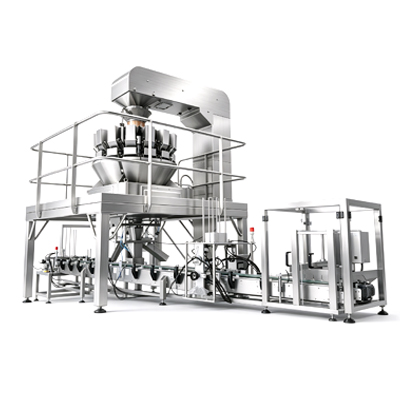
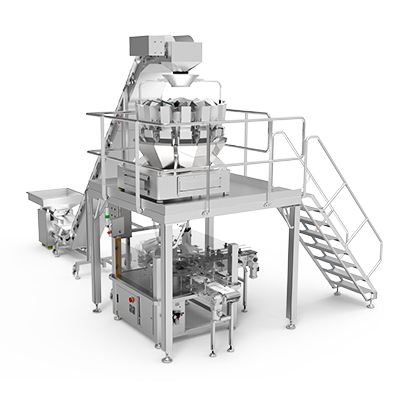
A: The top head shown is the standard auger/cup unit for powder and granule. For liquid and paste we fit a pump head instead, and—because the path is inline—we can dose in two calm stages (fill, then settle/top-up) so viscous products do not foam into the seal. That staged approach is exactly why the frame doubles as a horizontal liquid packaging machine.
Q: A 280 × 400 mm, 3000 ml pouch is large—will it seal and stand reliably?
A: Yes. The horizontal grippers hold the bag square throughout, and a bottom-support forms the gusset before sealing, so large, heavy packs close flat and stand upright. This large-format stability is the core reason buyers specify it as a large pouch packaging machine.
Q: We pack fine powder—how do you stop dust ruining the seal?
A: A seal-cleaning / dust-extraction station is placed immediately before the jaws, and the product path is enclosed, so the seal faces meet clean. This keeps leakers and rework low even on dusty powders and spice blends.
Q: Is 30–60 bpm enough output for us?
A: For large bags, liquid and multi-product lines it is a strong, sustainable figure, and the wide format range often means fewer changeovers than a faster but rigid machine. If your volume target is higher, two TY-280Z lines run in parallel on a shared outfeed—a common, low-risk way to scale without moving to a more complex architecture.
Q: What about voltage, installation and spare parts?
A: Voltage and frequency are configured to your plant, contact-material grade is selected to your audit, and commissioning guidance, operator training, a recommended spares list and remote diagnostics are included, with on-site service by arrangement.
Contact Us
Send us three things and our engineers will design the rest: a sample (or drawing) of your empty pouch with dimensions, the physical state of your product (powder, granule, liquid or paste), and your target packs per minute. From that we return a recommended station layout, a dosing-head selection, a speed study and a firm quotation.
Product Description
Submit Your Requirements
Please submit your requirement form, and we will customize the most suitable solution according to your needs.
Automated mesh bagging extends produce shelf life by providing vital airflow. Upgrading your line slashes labor costs, stops product giveaway, and maximizes daily output.
Dust-controlled powder fillers use vacuum extraction and servo-driven augers to package fine materials. These automated systems prevent waste, ensure safety, and maximize ROI.
Horizontal packaging machines use lateral movement to safely package solids, powders, and liquids. These systems ensure leak-proof seals, cut labor costs, and maximize your ROI.
It is a high-tech enterprise specializing in the R&D, design, and independent manufacturing of packaging, conveying, weight detection, weighing, and filling equipment.