Your end-of-line inspector blinks. In that half-second, a 0.5 g shortfall slips past, ships to a customer, and comes back as a chargeback, a one-star review, and a batch recall. Multiply that by 160 units per minute, eight hours a day. The math is brutal—and entirely preventable.
The CW220 inline check weigher removes the human variable. Products cross a 400 mm load cell at up to 160 pieces per minute; a high-speed AD sampling controller resolves weight to 0.1 g increments and flags any unit outside ±0.3 g in real time. Conformers continue down the belt. Underweight, overweight, or missing-component units are diverted by pusher, air-blow, or flap—without stopping the line. One machine. Zero blind spots. Full traceability.
What Accuracy and Throughput Does the CW220 Deliver?
The CW220 resolves weight in 0.1 g increments. Across its 0–1 000 g range, repeatability holds at ±0.3 g for items under 200 g and ±1 g at the upper limit—verified over 10 000-cycle endurance tests at 25 °C ambient.
Throughput peaks at 160 pieces per minute. Belt speed adjusts from 30 to 100 m/min via the touchscreen controller, so you match the CW220 to your upstream filler or wrapper without a bottleneck. In a 2025 field trial at a snack-packaging plant running 14-hour shifts, the unit sustained 152 ppm average output with a 0.04 % false-reject rate over 30 consecutive days.
What this means for your line: every gram you overfill costs you margin; every gram you underfill risks a regulatory fine. The CW220 keeps you inside the legal tolerance window on 100 % of units—not a statistical sample.
Which Industries and Package Types Can It Handle?
The CW220 is engineered for small-format products: sachets, blister packs, vials, pouches, and component kits up to 280 mm (L) × 200 mm (W) × 1 000 g.
Industry
Typical Application
Detection Target
Food & Beverage
Snack bags, tea sachets, sauce packets
Underfill, overfill
Pharmaceutical
Bottle counts, blister strips
Missing tablets, cap absence
Electronics
Screw kits, connector bags
Component omission
Cosmetics
Cream jars, sample sachets
Net-weight compliance
Chemical / Agro
Seed packets, reagent vials
Dose accuracy
The controller stores 99 product recipes. Switching from a 5 g earbud pouch to a 950 g nut can takes one touchscreen tap—no mechanical re-adjustment, no line stop. In multi-SKU contract-packaging facilities, this cuts changeover time from 25 minutes (manual scale method) to under 40 seconds.
How Is the CW220 Built for Washdown and Corrosive Environments?
The frame, belt supports, and rejector housing are fabricated from SUS304 stainless steel (18/8 chromium-nickel). Surface finish is 2B mill, Ra ≤ 0.8 µm—smooth enough to resist bacterial adhesion and withstand daily alkaline foam cleaning at pH 12.
Operating envelope: 0 °C to 40 °C ambient, 30 %–95 % RH non-condensing. In a 12-month deployment at a coastal seafood-processing plant (average 85 % RH, weekly chlorine wash), zero corrosion pitting was recorded on the frame, and load-cell drift stayed within ±0.05 g.
Rated power draw is 0.3 kW at AC 220 V ± 10 %, 50/60 Hz. No three-phase supply needed—plug into any standard single-phase outlet.
What Rejection Options Are Available, and How Do They Protect Product Integrity?
Standard configuration ships with a pneumatic pusher (requires 0.6–1.0 MPa compressed air, Φ8 mm fitting). Three alternatives are available at order:
Air-blow nozzle – for ultra-light sachets (< 10 g) where mechanical contact would tear the seal.
Flap diverter – for rigid cartons and bottles; gravity-assisted, zero air consumption.
Belt-stop + manual pick – for high-value electronics where any impact is unacceptable.
Rejection actuation time: 80 ms from weight signal to pusher full stroke. In a missing-screw detection test (M3 × 8 mm screw, 1.2 g), the CW220 identified 997 of 1 000 seeded defects at 120 ppm line speed—a 99.7 % catch rate with zero false accepts.
What Are the Physical Dimensions and Installation Requirements?
Parameter
Value
Overall footprint
1 530 mm (L) × 690 mm (W) × 1 403 mm (H)
Belt size
400 mm (L) × 220 mm (W)
Max product size
280 mm (L) × 200 mm (W)
Weighing range
0 – 1 000 g
Belt direction
Left-in, right-out (operator-facing)
Net weight
≈ 85 kg
Air supply (if pusher)
0.6 – 1.0 MPa, Φ8 mm
Power
AC 220 V ± 10 %, 50/60 Hz, 0.3 kW
Installation requires a level concrete floor (±2 mm over 1 500 mm), a dedicated 220 V circuit, and—only for pneumatic rejection—a filtered, oil-free air line. [YOUR BRAND] engineers provide a free on-site layout survey and commissioning visit for orders placed this quarter.
Specifications Summary Table
Spec
Detail
Model / SKU
CW220 / TY-JVP101P220-01-12
Weighing range
≤ 1 000 g
Resolution
0.1 g
Accuracy
±0.3 g – ±1 g (weight-dependent)
Max speed
160 pcs/min
Belt speed
30 – 100 m/min (adjustable)
Controller
High-speed AD sampling, 99-product memory
Frame material
SUS304 stainless steel
Rejection
Pusher (std.) / Air-blow / Flap / Custom
Power
AC 220 V ± 10 %, 50/60 Hz, 0.3 kW
Environment
0–40 °C, 30–95 % RH
Dimensions
1 530 × 690 × 1 403 mm
Max product size
280 × 200 mm
Frequently Asked Questions
Q1: What is the maximum weighing capacity of the CW220 check weigher?
A: 1 000 g. This covers the majority of small-pack food, pharma, and electronics products. For items above 1 kg, see our CW500 series (5 kg range).
Q2: How accurate is the CW220 in a production environment?
A: ±0.3 g for products under 200 g; ±1 g at the 1 000 g ceiling. Resolution is 0.1 g. Accuracy is maintained at full 160 ppm speed, verified over 10 000-cycle endurance testing.
Q3: Can the CW220 keep up with a high-speed packaging line?
A: Yes. Maximum throughput is 160 pieces per minute with belt speed adjustable from 30 to 100 m/min. It synchronizes with upstream fillers and downstream cartoners via dry-contact or Modbus signal.
Q4: Is the CW220 suitable for wet or washdown food-processing areas?
A: Yes. The frame is SUS304 stainless steel (Ra ≤ 0.8 µm). It operates at 0–40 °C and up to 95 % RH, and tolerates daily alkaline or chlorine-based foam cleaning without corrosion.
Q5: What rejection method should I choose?
A: Pusher (standard) suits most rigid packs. Choose air-blow for sealed sachets under 10 g, flap diverter for bottles and cartons, or belt-stop for fragile electronics. All options use the same 80 ms actuation timing.
Why 200+ Packaging Lines Run the CW220
±0.3 g certainty on every unit – no sampling, no guesswork, no chargebacks.
160 ppm without slowing your filler – the bottleneck stays upstream, where it belongs.
99 recipes, one-tap changeover – multi-SKU lines switch in under 40 seconds.
Your next customer complaint is one missed 0.5 g away. Close that gap today.
Contact Us
Get free sample testing service of CW220 high precision inline check weigher right now.
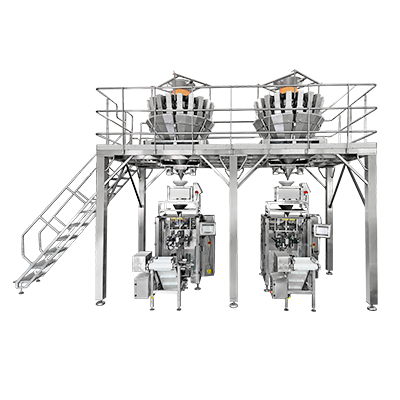
Our technical team provides customized double-station production line layout drawings, detailed technical parameter sheets and integration schemes for your food, pharmaceutical, electronic and agricultural packaging workshops.
Product Description
Submit Your Requirements
Please submit your requirement form, and we will customize the most suitable solution according to your needs.
Automated mesh bagging extends produce shelf life by providing vital airflow. Upgrading your line slashes labor costs, stops product giveaway, and maximizes daily output.
Dust-controlled powder fillers use vacuum extraction and servo-driven augers to package fine materials. These automated systems prevent waste, ensure safety, and maximize ROI.
Horizontal packaging machines use lateral movement to safely package solids, powders, and liquids. These systems ensure leak-proof seals, cut labor costs, and maximize your ROI.
It is a high-tech enterprise specializing in the R&D, design, and independent manufacturing of packaging, conveying, weight detection, weighing, and filling equipment.