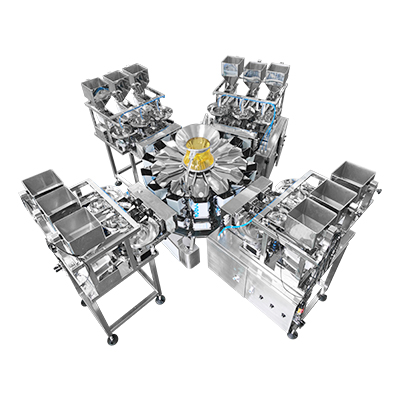
Last year, a client from Thailand named Lin came to visit our factory. His family has been making biscuits and snacks for three generations, and their factory is on the outskirts of Bangkok. We'd been chatting online for two weeks, but he still wasn't convinced — so he booked a flight and came to see for himself.
The afternoon he arrived, he didn't want to go to the meeting room. "Workshop first," he said.
When we stopped in front of our Rotary Collecting Table, he pressed his palm against the tabletop, then grabbed the edge with both hands and shook it hard. Nothing moved. Then he squatted down, turned on his phone flashlight, and started examining every single weld — front side, then back side, running his finger along each seam.
He stayed down there for about twenty minutes. When he finally stood up and wiped the dust off his hands, he said something to his translator.
The translator turned to us: "He says he bought two cheaper ones before. Less than a year, the tabletop caved in and the welds all rusted. He says he can tell just by touching this one — it's different."
He ordered three units that same day. It's been over half a year now, and last month he messaged us saying all three machines run every single day without a single issue. He's about to order two more for a new production line.
You Can Find Cheaper Ones for a Few Hundred Bucks — But Would You Ship Them Overseas?
There are rotary collecting tables out there that cost only a few hundred dollars. At first glance, they all look the same: it's just a rotating table, right?
But the difference shows up once you actually use them.
A client from the Middle East once told us about his bad experience. Three years ago, he bought two cheap tables from another supplier. The price was tempting. But within six months, the tabletops started sagging — his products were canned goods, heavy, and the thin steel just couldn't handle the weight. The motors were weak too — they buzzed loudly and sometimes got stuck mid-rotation, so workers had to nudge them by hand. Worst of all, the welds started rusting. The climate there is hot and humid, and thin steel with basic welding rusts faster than you'd expect.
He told us about the worst time — they were rushing a big order, one machine broke down completely, and the other kept stalling. The whole packaging line backed up, products piled everywhere, and they had to pull extra workers to manually sort and pack. They still missed the deadline and had to pay the buyer a penalty.
Here in China, if a machine breaks, you call a technician and get it fixed. But overseas? Your client doesn't know anyone, can't find spare parts, and one dead machine can bring the entire production line to a halt.
We've been doing export business for years, so we know this pain point all too well. That's why we designed this Rotary Collecting Table with one goal in mind: ship it out and never hear a complaint.
How Solid Is It, Really? Here Are the Details
Full 304 stainless steel construction — not a thin "veneer" over cheaper metal. The body and support frame are both stainless steel, and the tabletop is a stainless steel concave surface with a 1200mm diameter. We once had a Russian client visit — he weighed over 200 pounds, and he stepped right on the edge of the tabletop to test the strength. The machine didn't budge. Net weight is 58.3kg, packed weight 127kg. The weight itself tells you something — you can't get that kind of heft without real material.
Concave curved tabletop design. Products naturally gather toward the center instead of scattering everywhere. One of our clients makes hardware fittings — small screws and washers. With his old flat table, parts would fly to the edges as it spun, and workers had to keep pushing them back. After switching to our concave table, everything collects in the middle automatically. Workers just stand in one spot and pack — much more efficient.
0.55kW motor (0.37kW with the domestic simple control box) — enough power, smooth rotation. Continuous operation without jamming, and it's quiet. A food factory client told us his old machine was so loud that people had to shout to talk over it. With ours, they can have a normal conversation. Speed is adjustable too — fast pace, slow pace, whatever your production rhythm needs. Switching between different products doesn't require switching machines.
Welding and polishing done right. Every weld is solid, and every edge is ground smooth — no sharp corners to cut your hands. For food and daily chemical clients who care about hygiene, the rounded design is also easier to clean — no crevices where dirt can hide. A daily chemical client told us his old machine had sharp edges that cut workers' gloves (and sometimes hands). After switching to ours, that never happened again.
Adjustable feet. Factory floors overseas aren't always level. Just twist the four feet to level the machine. A Vietnamese client has an old factory with a slightly uneven concrete floor — his old machine wobbled, but after adjusting our feet, it sat perfectly stable. He even sent us a video to show us.
Two Control Box Options — Same Function, Different Markets
We offer two configurations based on where the machine is going:
· Domestic (China): Simple control box (inverter + power switch), 0.37kW motor — practical and cost-effective
· Export: Standard control box with Start, Stop, and Run status indicators, 0.55kW motor — more standardized operation, matches local usage habits
The functionality is identical — just different control box styles. Power supply supports single-phase/three-phase, 220V/380V, 50Hz/60Hz, so it works directly in most countries without needing a transformer.
Who's Using It? More Industries Than You'd Think
Food processing, hardware fittings, packaging, daily chemicals… any scenario where packaged products need temporary storage before workers sort them into cartons — this machine fits right in.
Biscuits and bread: Packaged bags drop onto the table, rotate slowly to the worker, and get packed into cartons
Screws and nuts: Small parts in bags gather in the concave center — no scattering
Shampoo and body wash: Heavy bottles, but the table handles the weight and spins smoothly
Toys and small goods: Put one at the end of your packaging line, and workers don't have to run back and forth
Concave gathering + electric rotation + adjustable speed — workers stay in one spot, products come to them, and packing efficiency goes up noticeably.
Let's Be Honest
If you just need something temporary and your budget is extremely tight, those few-hundred-dollar machines will get you by.
But if you're exporting overseas, or you want a machine that runs reliably for years without constant repairs — come take a look at our Rotary Collecting Table. We've shipped many units abroad — Thailand, Vietnam, Malaysia, Russia, the Middle East — and the feedback has been consistently solid.
You get what you pay for. Anyone who runs a factory knows that. Good equipment doesn't hide from inspection. Come visit our factory, put your hands on it, and you'll feel the difference.
Want to know pricing, custom dimensions, or export packaging options? Get in touch with us.
Technical Specifications
Parameter | Details |
Main Body Material | 304 Stainless Steel |
Tabletop Material | Stainless Steel |
Tabletop Type | Concave Surface |
Tabletop Diameter | 1200mm (customizable) |
Power Supply | Single/Three Phase, 220V/380V, 50Hz/60Hz, 0.55kW |
Tabletop Height | 750mm±50mm (minimum 550mm) |
Net Weight | 58.3kg |
Packed Weight | 127kg |

20 YEARS Focus on
Poviding intelligent weighing
and packaging solutions